
Sandy Springs authority approves bond resolution to fund city parking in Hudson Center redevelopment
Get AI-powered insights, summaries, and transcripts
Subscribe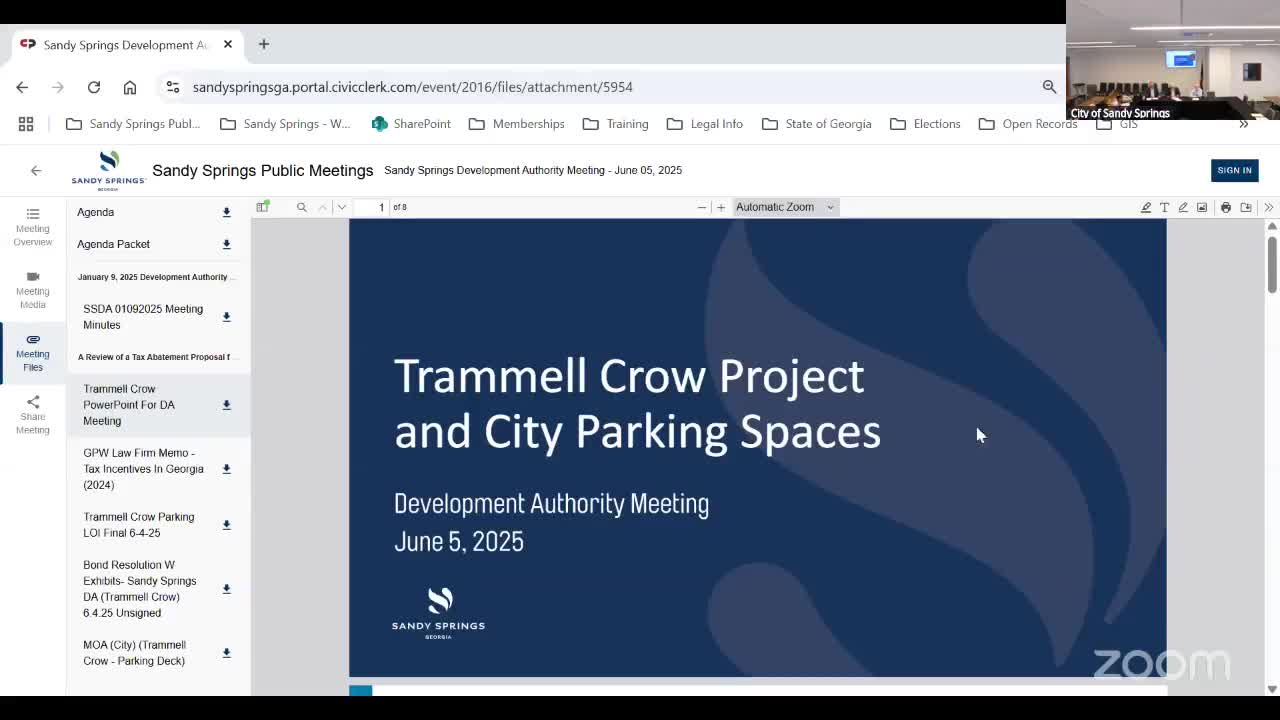
Summary
The Sandy Springs Development Authority voted to authorize a bond-resolution framework tied to a 10-year Fulton County tax abatement that will fund construction of 111 city-designated parking spaces inside a new mixed‑use garage at the former Hudson Center (Sandy Springs Methodist Church) site.
The Sandy Springs Development Authority voted Tuesday to authorize a bond-resolution framework that supports a private mixed‑use redevelopment at the former Hudson Center site and channels tax‑incentive payments to build 111 parking spaces the city will control for events and public use.
The vote, taken during the authority’s May 8 meeting, follows presentations from city staff and the development team about the project planned by Trammell Crow Residential with an Atlanta firm for the retail component. Chris (staff member) described the proposal as “a big win for us,” and said the development would replace surface parking the city currently uses for City Springs events.
Why it matters: the church property is now tax‑exempt. Under the structure outlined to the authority, the redevelopment will enter the county tax rolls and qualify for a 10‑year Fulton County tax incentive schedule; a portion of the tax savings will be paid back to the public authorities and used to pay for the city’s 111 spaces, street and pedestrian improvements and transaction costs. Authority staff said using the developer’s garage to replace lost surface parking will be materially cheaper per space than building a new municipal deck.
Most important facts: the redevelopment proposal covers the southwest corner of Mount Vernon Road and Sandy Springs Circle on roughly an 80.1‑acre parcel owned by Sandy Springs Methodist Church. The project as presented includes about 362 multifamily rental units (the staff slide noted roughly 393 units in an alternate estimate), 30 luxury rental townhomes, and about 18,000 square feet of retail and restaurant space. The city negotiated that 111 garage spaces will be added and made available to the city for events under a long‑term easement; staff said the city’s hard construction cost for those spaces is estimated at $3,312,000 and that the developer may buy out the city’s parking easement by paying 200% of that hard cost ($6,624,000).
How the financing and agreements would work: authority staff explained the typical Fulton County structure under which a 10‑year tax abatement phases in (50% reduction in year one, increasing by 5 percentage points annually until full taxation in year ten). Staff projected first‑year taxes on the redeveloped property in the neighborhood of $1.06 million (using assumptions outlined in the presentation) and estimated total nominal abated taxes over the 10‑year term at roughly $4.8 million (staff also presented a net‑present‑value figure near $3.6 million). The authority would receive contractual payments tied to that tax incentive to reimburse the city for the parking construction, infrastructure work (staff estimated about $900,000 for sidewalks, crossings and streetscape), legal and transaction costs, and a modest development authority fee.
Terms and management: staff said the parking easement and related agreements would be drafted as a tri‑party set of documents among the property owner/developer, the Sandy Springs Development Authority and the city (the Public Facilities Authority was referenced in the presentation). The initial nonbinding letter of intent was described as in draft form; staff said the authority’s approval authorizes completion of the required tax‑incentive and bond‑related steps and to proceed toward ratification by the city council at its June 17 meeting and subsequent closing. Staff also said the 50‑year parking agreement would “run with the land,” but include a buyout option and require the city to share prorated operating and capital maintenance costs for its portion of the garage.
Deliberation and vote: board members asked about day‑to‑day use, overflow, enforcement and whether the 111 spaces would serve the new site’s retail. Staff replied that the 111 spaces are in addition to the private parking being built for residents and are intended for city events; when city use is not required the developer may use the spaces under permitting rules or sell parking for overflow. After discussion about timing, costs per space and the infrastructure improvements the authority took a motion to approve the bond‑resolution authorization as presented. Sasha Battle moved; Hardy Dorsey seconded. The motion passed by recorded voice vote.
What was not decided: staff and the developer remain finalizing the parking‑easement, reimbursement and related documents. The authority’s action authorized the tax‑incentive/bond process and document development; final execution of the parking easement, the reimbursement contract and closing documents will return to the authority and the city council for ratification, staff said.
Context and next steps: staff said the development required no rezoning and is privately financed (a typical 60/40 debt/equity structure was discussed as illustrative). If the authority and council decline to approve the tax‑incentive structure, presenters said the private project can proceed without the city’s parking contribution and the city would need to identify alternative replacement parking. Staff said they intend to return to the authority with final agreements before closing and that the council will consider ratification at its June 17 meeting.
The authority’s presentation listed Trammell Crow Residential as the lead developer, Third & Urban (retail partner) as the retail developer, New South Construction as the general contractor and CBRE as leasing agent. Authority staff said legal counsel and fiduciary agents are engaged and that the validation and tax schedule steps required by the county and state process will follow standard timelines.