
Executive committee backs Elgin TIF support letter after heated public comments; panel also advances a bundle of contracts and budget items
Get AI-powered insights, summaries, and transcripts
Subscribe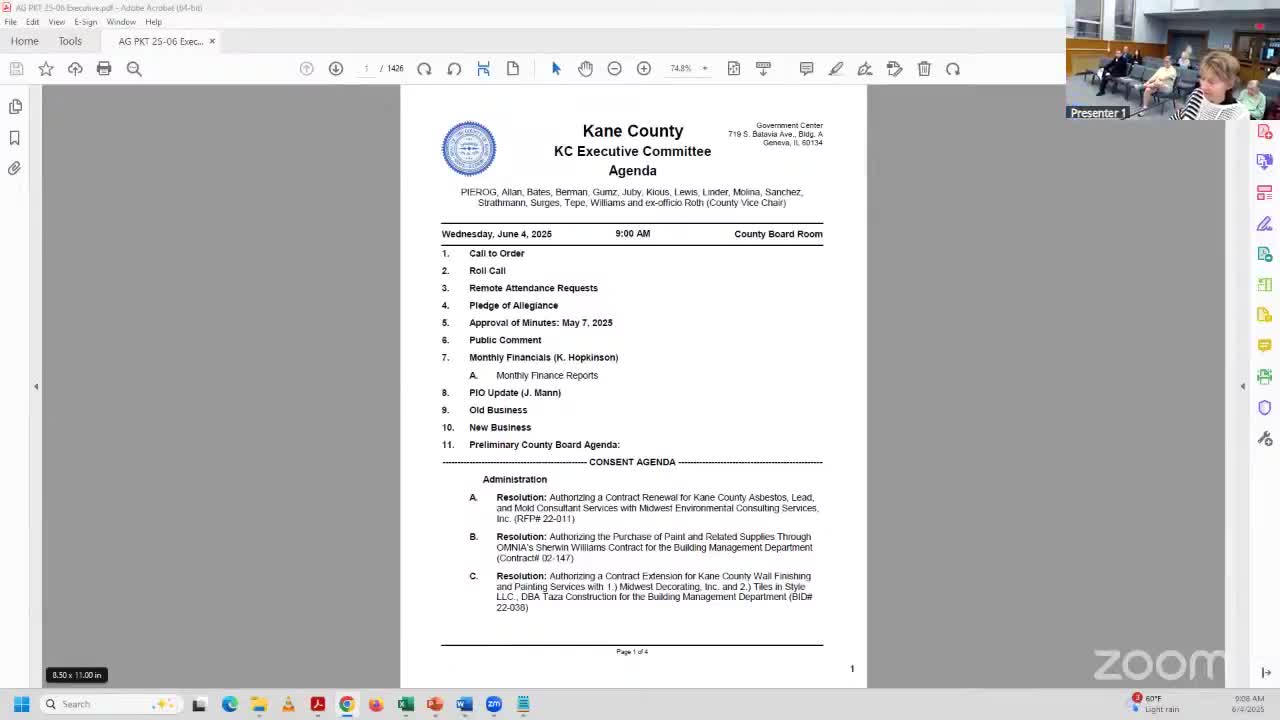
Summary
Kane County’s executive committee voted on June 4 to forward a letter supporting a 12-year extension of the City of Elgin’s Central Area TIF to the full county board after public commenters disputed the fiscal effects of the extension.
Kane County’s executive committee voted on June 4 to forward a letter supporting a 12-year extension of the City of Elgin’s Central Area tax increment financing district to the full county board, after more than 20 minutes of public comment and debate among board members.
At the meeting, several residents urged the committee to reject the support letter because they said TIFs divert property-tax revenue from schools, libraries and other taxing bodies. Janine Meyer, a resident and public commenter, urged the committee to “reject the letter to support to extend it,” saying TIFs have diverted “somewhere in the ballpark of $17,000,000 in property tax revenue” from taxing districts over 23 years. Carl Dinwiddie, who said he has tracked TIFs for 25 years, told the committee that between 2015 and 2024 the county’s TIF increment share grew in both dollars and as a share of county revenue.
City of Elgin officials told the committee the city has no outstanding debt tied to the Central Area TIF and described the extension as part of ongoing redevelopment work. Rick Kozel, City Manager for Elgin, said the city “does not have any outstanding debt relating to the developments in the central area TIF project.”
After discussion the executive committee voted to move the letter of support to the full county board. The roll call recorded a majority of yes votes; the motion carried with several members voting no and a small number abstaining.
Why this matters: Tax increment financing allows a municipality to capture future growth in property taxes within a designated area to pay for improvements in that area. Local opponents told the committee an extension would continue to divert revenue that otherwise would flow to county services, the forest preserve and school districts; proponents said an extension will enable ongoing redevelopment that they expect to benefit the local economy over time.
Votes at a glance - Letter of support for a 12-year extension of Elgin Central Area TIF (moved to full board): moved off consent and forwarded to county board; roll-call vote recorded a majority in favor with multiple no votes and abstentions. - Contract renewals and procurement approvals (consent/roll-call votes): the committee approved a series of building management, janitorial, painting, electrician and wireless contracts, including a renewal for asbestos/lead/mold consulting services (up to $200,000/year), Wall Finishing and Painting Services contract extensions, janitorial supplies (up to $140,000/year), electrician services (up to $250,000/year), and cellular/wireless services agreements with AT&T (combined increases noted in the agenda). - Omnia/Sherwin-Williams paint contract: the committee debated a resolution to authorize painting supplies from the Omnia Partners/Sherwin-Williams national contract (up to $40,000/year). Members discussed procurement thresholds and the county’s ability to purchase below and above the $30,000 competitive threshold. The contract vehicle was described as offering a guaranteed 30% discount and, in practice, larger volume discounts. The committee ultimately handled the item and it proceeded to a roll-call approval. - Axon Enterprises amendment (electronic discovery/transcription features): the committee approved an amended contract request by the State’s Attorney’s Office to expand electronic discovery and transcription features, including AI-assisted case summaries, phone extraction and bilingual transcription capabilities. The office said the funding for the amendment is expected to come from restricted technology funds (RTA/related program funds) rather than the county general fund. - Sheriff’s bargaining agreement: the committee approved a collective bargaining agreement covering the Sheriff’s Office public safety staff through 2026. The committee’s budget discussion noted the sheriff will absorb cost increases in 2024 and 2025, while the 2026 budget will need to accommodate a projected additional salary cost of roughly $3.16 million; that increase will be considered during the 2026 budget process. - Other notable approvals: the committee approved a pair of public-safety items (electronic monitoring service agreement and purchase approval for a bomb/robot replacement system), several transportation contracts and intergovernmental agreements, and a resolution dissolving the Office of Community Reinvestment and transferring program management and staff to the Development Department (with an adjustment to the development director’s salary included in the resolution).
Key details and clarifications from the meeting - Public comment figures: several public commenters offered numbers for TIF impacts. Janine Meyer and Carl Dinwiddie attributed specific dollar estimates (for example, a claim that the county would forfeit about $4.6 million over the proposed 12-year extension). Those figures were presented as the speakers’ calculations and were not independently certified during the meeting. - County finance update: Kathleen Hopkinson, Finance Director, told the committee county packets include budget-to-actuals and that the county is implementing a forecasting tool (Workday Adaptive Insights); she warned the committee that the county’s local use tax receipts dropped after a statutory change effective January 1, reducing expected receipts by roughly $1 million annually, and that the grocery tax elimination set for 01/01/2026 makes precise revenue projection difficult because grocery sales are not separately coded in state reports. - Emergency rental assistance: Mark Van Kirkhoff (Treasurer’s Office/administration) said the county has approximately $600,000 available in federal emergency rental assistance funds and will accept applications through July 31 to spend out the grant before the federal close-out in September. - Procurement/Omnia explanation: Roger Fonstock, director of building management, explained that Omnia Partners is a national cooperative purchasing vehicle; the county’s local Sherwin-Williams store currently provides significant volume discounts and the Omnia contract furnishes a not-to-exceed guarantee that protects the county from paying above-market rates.
What’s next - The Elgin TIF letter will be considered by the full Kane County Board at its next meeting; interested residents and officials can expect additional debate there. Multiple procurement items and the enacted agreements will be implemented by county staff under the terms approved by the committee.
Sources and attributions Quotes and attributions in this article come from the meeting transcript for the Kane County Executive Committee meeting on June 4, 2025. Direct quotes in the article are attributed to speakers who spoke on the record at the meeting.
Ending: The committee’s actions advance several administrative contracts and a set of policy matters to the full county board; the TIF letter — the meeting’s most contested item — will be decided next at the full board level where additional public comment and board debate are scheduled.