Get Full Government Meeting Transcripts, Videos, & Alerts Forever!
Get email alerts on the Historic Zoning topic
No spam. Unsubscribe anytime.
Ben Mosley defends historic-zoning approach as commissioners ask about diversity, precedent
Summary
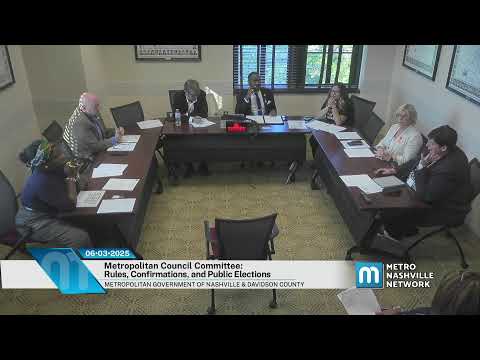
Ben Mosley, a candidate for reappointment to the Historic Zoning Commission, told the Rules, Confirmations & Public Elections Committee that his architecture background and long local experience qualify him for another term.
Ben Mosley, a candidate for reappointment to the Historic Zoning Commission, told the Rules, Confirmations & Public Elections Committee that his architecture background and long local experience qualify him for another term.
Mosley said he holds a bachelor of architecture degree from Auburn University, has worked professionally in Nashville since 1997 and has experience drafting neighborhood design guidelines. “I fulfill one of the unicorn positions that's required of the commission being an architect,” Mosley said during his interview. He also said he has worked with staff and current commissioners across multiple administrations and that he has been involved in preparing guidelines in districts including Germantown and East Nashville.
Committee members pressed Mosley on whether historic overlays tend to be created in less‑diverse neighborhoods and how the commission balances consistency with flexibility. Mosley acknowledged the tension and described the commission’s work as nuanced, saying that guidelines are not strictly formulaic and that design decisions require judgment: “I think there’s more than one or two ways to fit in… I would say if you polled other commissioners, I’m perhaps more permissive in terms of what the design aesthetic might be,” Mosley said.
A committee member asked whether the commission’s conventional 1945 cutoff for some overlays is arbitrary. Mosley answered that 1945 is “a relatively arbitrary marker” and that significance depends on architectural patterns and context. He said the commission looks at features such as roof pitch and window openings when evaluating new construction in historic districts.
Another committee member raised concerns that some overlay decisions have been driven by residents seeking to prevent neighborhood change and said those decisions can have racial and housing‑supply consequences. The member said of a past overlay: “I think it was mainly driven by people who didn’t want to see the neighborhood change, who were mainly white… we have a housing shortage in this city.” That member said the city must be careful about applying overlays in ways that could contribute to gentrification.
After questioning, the committee voted to forward Mosley’s reappointment. The committee recorded a vote tally of six in favor, zero opposed and one not voting.
Mosley is proposed for a term expiring 06/30/2030; the committee’s packet noted a date discrepancy on the agenda that was corrected during the meeting. The committee did not take up any changes to the commission’s legal standards during the hearing.
The committee moved on after the vote to other appointments and administrative items.