Get Full Government Meeting Transcripts, Videos, & Alerts Forever!
Get email alerts on the Criminal Assault topic
No spam. Unsubscribe anytime.
Appeals court hears dispute over whether pointing gun and saying "I'll ******* shoot you" proved imminent threat
Summary
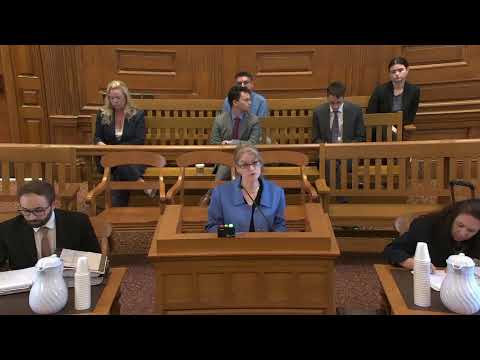
An Appeals Court panel of Justice Mead, Justice Ditkoff and Justice Hirschvang heard oral argument in case 24P699, Commonwealth v. Fagan, on the sufficiency of the evidence for an assault-by-means-of-a-dangerous-weapon conviction and a related ineffective-assistance claim.
An Appeals Court panel of Justice Mead, Justice Ditkoff and Justice Hirschvang heard oral argument in case 24P699, Commonwealth v. Fagan, on the sufficiency of the evidence for an assault-by-means-of-a-dangerous-weapon conviction and a related ineffective-assistance claim.
Stephen Goldman, counsel for the Fagans, told the panel that the Commonwealth did not prove beyond a reasonable doubt that the defendant had the intent to place the alleged victim in imminent fear of a battery or that a reasonable person would have apprehended imminent harm. Goldman described the incident as a “glorified road rage” episode occurring in daylight at a gas station and argued that, in that context, it was not reasonable to infer the gun would be fired. “It's not reasonable to think that that person is actually gonna pull the trigger under those circumstances,” Goldman said.
Goldman focused on three arguments: (1) the context of an ordinary road‑rage encounter made an actual shooting unlikely; (2) the defendant’s words—variously described in the transcript as “I'll ******* kill you” or “I'll ******* shoot you”—should be read as a future or conditional statement rather than an immediate present threat; and (3) the alleged victim’s conduct after the incident (Goldman noted the victim “did not duck, did not scream, did not floor it and get out of there”) showed disbelief rather than apprehension, undermining the objective-standard inquiry about reasonable apprehension.
Assistant District Attorney Dylan Punch, arguing for Middlesex County and the Commonwealth, said the combination of a firearm “pointed directly at the victim's face” and the statement “I'll ******* shoot you” removed temporal uncertainty and supported a finding of imminent apprehension. “Having a firearm pointed directly at your face is fairly strong evidence that someone is imminently going to shoot you,” Punch said, noting the victim testified he was “waiting to see whether or not the defendant was going to shoot me.”
On the ineffective-assistance issue, Goldman argued trial counsel failed to present an argument now raised on appeal and failed to develop a record showing whether a misdemeanor plea had been offered and, if so, whether it was communicated to the defendant. Punch replied there is no affidavit or other record evidence showing a plea offer existed and that the lower court properly denied a hearing on the ineffective-assistance motion because the papers did not present a substantial issue.
The justices interrupted at points to question counsel about the grammatical framing of threatened language, what a reasonable person would perceive and whether the victim’s on-scene reactions mattered to the objective standard. After argument the panel said it would take the case under advisement.
The panel did not issue a decision at oral argument; the matter was submitted for decision following argument.