Get Full Government Meeting Transcripts, Videos, & Alerts Forever!
Get email alerts on the Short Term Rentals topic
No spam. Unsubscribe anytime.
Parowan planners debate broad short-term rental rules; favor on-call local contact over hosted requirement
Summary
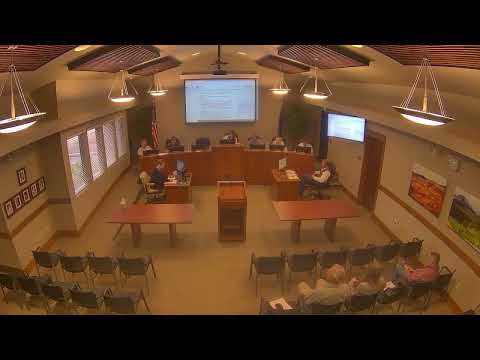
The Parowan Planning and Zoning Commission reviewed a draft short‑term rental ordinance on June 4, 2025, and discussed zoning, local ownership, enforcement and limits on new short‑term rentals but took no formal vote.
The Parowan Planning and Zoning Commission reviewed a draft short‑term rental ordinance on June 4, 2025, and discussed zoning, local ownership, enforcement, and limits on new STRs but took no formal vote.
Commissioners and staff focused on operational requirements and enforcement. Dan, a staff member presenting the draft, said the proposal included a purpose, definitions, permitted zones, a licensing requirement, operational requirements and limitations on new STRs, and noted “we could just say it has to be hosted anywhere in the city or we can not regulate it on hosted or unhosted.”
Why it matters: Commissioners said Parowan faces pressure from vacation‑rental demand and wants rules that protect neighborhood character and long‑term housing while allowing supplemental income for homeowners. The commission discussed how to prevent corporate absentee owners from buying multiple units without local accountability and how to manage enforcement without a large administrative burden.
Most significant details
- Operational requirement preferred: Commissioners generally favored allowing unhosted STRs across zones if an on‑call “local contact person” is designated, lives or is located within a 30‑mile radius of Parowan, and can physically respond to complaints within 30–60 minutes. Dan read the draft definition: a “local contact person…available 24 hours a day, 7 days a week, and capable of physically responding to the rental property within 30 to 60 minutes.”
- Local ownership vs. local contact: The draft included an option (number 6) to require a short‑term rental license only for natural persons whose primary residence is within Parowan or a 30‑mile radius, or for business entities whose controlling persons live locally. Staff and commissioners debated legal defensibility of residency‑based ownership limits. Scott, a staff/legal participant, cautioned about constitutional and property‑use limits: “you cannot infringe upon the rights of persons use and enjoyment of their property based upon residency.” Commissioners responded that a local contact requirement might achieve oversight without raising the same legal risk.
- Caps and saturation: The draft listed options including a citywide cap (5% commonly cited in discussion), a separation requirement (for example 300 feet from another STR), and neighborhood saturation limits. Commissioners asked staff to determine the current number of active STRs; staff reported 23 rentals with permits and estimated roughly 1,373 residences in the city, making a 5% cap approximately 68 permits. Commissioners discussed whether a 5% cap is too low and several suggested 10% might be a more acceptable limit; no decision was made.
- Licensing, fees and enforcement: The proposal would require an annual STR business license, proof of insurance, state and local transient room tax (TRT) registration, and nontransferable licenses that may be revoked for violations. Proposed enforcement measures included fines (examples discussed: $250 first offense, $500 second, $1,000 for repeat offenses) and a three‑strike (or two‑strike) trigger for license review. Dan said 3 violations in 12 months would trigger review in the draft; commissioners debated whether review should come after two or three violations.
- Safety, occupancy and inspections: The draft proposes safety checks (smoke detectors, fire extinguishers, carbon monoxide detectors) before issuance and periodically thereafter. Staff recommended inspection frequency be tied to annual relicensing (annual or every other year was discussed) and suggested charging inspection fees to cover administrative costs.
- Grandfathering and active‑use definition: Staff explained that existing short‑term rentals with an active business license at the ordinance effective date would be grandfathered but would still have to comply with operational requirements. For any cap, staff said the commission must specify how “active” is defined (e.g., last listing date, permit status, or a set timeframe) to avoid administrative ambiguity.
Quotes (selected, from the meeting transcript)
- Dan (staff member): “We could just say it has to be hosted anywhere in the city or we can not regulate it on hosted or unhosted.”
- Scott (staff/legal participant): “You cannot infringe upon the rights of persons use and enjoyment of their property based upon residency.”
- Commissioner Shane: “I would like them all just to be unhosted STRs as long as there is somebody that is within 30 miles that can take care of problems.”
Discussion versus action
The commission debated policy choices at length but did not vote on any ordinance language or schedule a public hearing. Staff said they will revise the draft to reflect the commission’s preference for a local contact requirement, further research legal defensibility of residency or ownership limits, and produce data on current STR counts to inform any cap decision.
Next steps
Staff will: refine the draft to emphasize a local contact requirement and response time, calculate current counts of STR listings and licensed rentals, and return with revised language for additional review before scheduling a public hearing.