Get Full Government Meeting Transcripts, Videos, & Alerts Forever!
Get email alerts on the Revenue topic
No spam. Unsubscribe anytime.
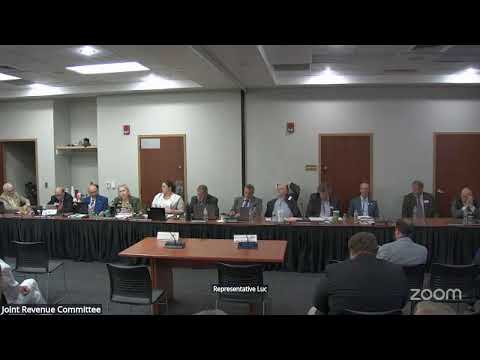
Wyoming revenue committee weighs property-tax reform, appeals process and acquisition-value options
Summary
The Wyoming Legislature's Revenue Committee heard extended testimony Wednesday on property-tax appeals, the scope of county boards of equalization, and proposals to change valuation rules including acquisition (purchase) value and implementation of Amendment A to the state constitution.
The Wyoming Legislature's Revenue Committee heard extended testimony Wednesday on property-tax appeals, the scope of county boards of equalization, and proposals to change valuation rules including acquisition (purchase) value and implementation of Amendment A to the state constitution.
Committee Chair Chairman Locke opened a wide-ranging discussion that included staff from the Legislative Service Office, the Department of Revenue and county officials, as well as public testimony. The committee voted to draft three items: a bill draft on acquisition-value reform, a draft to implement Amendment A's residential-class provision without creating the owner-occupied subclass, and a bill draft to revise the county appeals process and evidence exchange.
Why this matters: property taxes fund local services (schools, public safety, roads) and large valuation swings have prompted constituent complaints and proposed statewide reform. Committee members sought both legal guidance about what constitutional changes would be required and practical detail on how counties handle appeals and document exchange.
Josh Anderson, Legislative Service Office staff, told the committee the new constitutional language in Article 15, Section 11 gives the Legislature authority to “prescribe the percentage of value which shall be assessed within each designated class,” and that the committee could choose to define residential property at a percentage that preserves current revenue. Anderson also cautioned the committee that many legal and implementation questions remain unresolved about acquisition value’s constitutionality and administration.
Ken Gill, Department of Revenue, described the range of appeals the State Board of Equalization and courts hear. “If you're talking about locally assessed…that means local tax, property tax decisions made by assessors appeal to the county board, and then those are appealable to us and then appealed up to the district court and then Wyoming Supreme Court,” Gill said. He clarified the distinct pathway for state-assessed taxes (for example, sales and use tax or severance taxes): those begin at the state board and then move to district court and the Wyoming Supreme Court.
County practice and the role of county boards were a recurring theme. Committee members and witnesses described uneven familiarity between county commissioners and assessors about mass appraisal methods. A Department of Revenue witness said statutes do not clearly define what county boards may change; in practice, county boards may correct errors in assessed records but generally may not rework mass-appraisal methods. “They can really only look at what the assessor did and determine whether they made an error,” the witness said, citing 39-13-109 as the statutory reference discussed in testimony.
Several legislators asked whether taxpayers may use private appraisals or real-estate comparables as evidence. The Department of Revenue testimony noted such materials are accepted as evidence at the county level but are rarely dispositive against mass appraisal results unless they overcome the legal presumption of correctness. “The notion that it's not accepted at all, that is completely just completely wrong,” one department witness said.
Committee discussion also focused on timing and the appeals process. Statute offers a 30-day window tied to notice timelines and an evidence-exchange period before county hearings; witnesses explained that the 30-day evidence-exchange deadline is counted relative to the hearing date rather than from the filing date. County assessors said they commonly provide sales and the records used in a property's valuation at the time a taxpayer requests a review, and they try to resolve many issues administratively before a formal appeal is docketed.
Public testimony stressed caution. Cindy Barlow, testifying online, urged the committee to avoid hasty constitutional changes and warned that Amendment A’s creation of a residential-class distinction could have distributional effects for renters and commercial taxpayers. County Commissioner Scott Clem urged a targeted, incremental approach and recommended stakeholder engagement before major constitutional or distribution changes.
On outcomes, the committee approved motions to draft legislation: Representative Lien’s motion to draft a bill based on House Bill 282 (acquisition-value themes) was moved and seconded and advanced with a friendly request to include constitutional-change analysis and a fiscal note; the committee also approved a motion to draft a bill to implement Amendment A limited to the residential class (without immediately creating an owner-occupied subclass) and to draft a bill revising the appeal process based on an LSO draft (22 LSO-026). As part of the appeal-process draft, the committee added amendments including extending the appeal-notice window from 30 to 45 days and a requirement that documents used to determine property value be provided to appellants within three working days where practicable.
Committee members repeatedly framed reform as balancing predictability for taxpayers with stability for local governments that rely on property-tax revenue. Several legislators asked staff for fiscal notes on proposals and for county-level estimates of revenue effects, including the likely statewide cost if an owner-occupied reduction like the People’s Initiative were enacted.
The committee directed staff and the Department of Revenue to prepare bill skeletons, fiscal analyses and a list of documents typically used in valuation (for use in the evidence-exchange draft). Several members urged stakeholder engagement — county assessors, counties, school districts and municipal officials — before pursuing constitutional amendments or major distributional changes.
Looking ahead: the committee will receive LSO drafts and fiscal notes, county feedback on operational feasibility (document production timelines and workloads), and legal analysis on constitutional issues before further action.