Get Full Government Meeting Transcripts, Videos, & Alerts Forever!
Get email alerts on the Condominiums topic
No spam. Unsubscribe anytime.
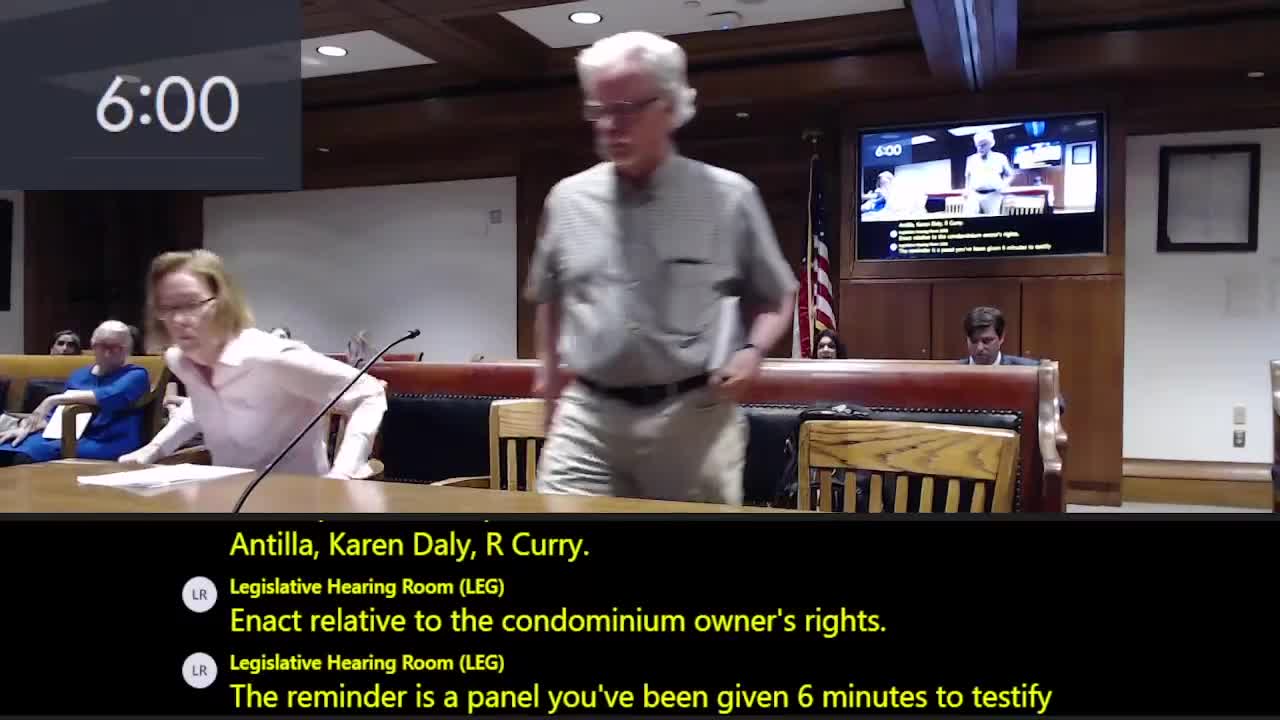
Condo owners push for transparency, board accountability in update to Chapter 183A
Summary
Witnesses urged the Joint Committee on Housing to update Massachusetts’ condominium law (Chapter 183A) to require stronger financial transparency, limits on surprise assessments and greater owner participation in governance.
Condominium owners, managers and advocates urged the Joint Committee on Housing to modernize Chapter 183A during testimony on Senate Bill S‑980, which would amend the commonwealth’s condominium statute to strengthen owner protections and transparency.
Why it matters: Condo communities house large numbers of residents — testimony cited roughly 11,000 associations and 1.6 million residents in Massachusetts (2021 data) — and many owners rely on predictable fees and accountable association governance.
Panelists described frequent problems with current practice: limited access to financial information, surprise special assessments, boards that make significant decisions without owner input, and no consistent training or fiduciary education for board members. “Board members are not required to have financial experience or board training,” testified Maureen McEnroe. “I've been told a few times by board members that they hold no fiduciary responsibility.”
Residents gave specific examples: one speaker said the association voted for a $2,000 per‑unit assessment and it later changed without owner consent to $147,766 total, and that maintenance items such as roof leaks persisted after a roof replacement; another said seniors in 55+ communities often have average ages in the mid‑70s to 80s, amplifying the harm of surprise fees.
Supporters of S‑980 pointed to reforms elsewhere in New England (Connecticut, Rhode Island, Vermont, New Hampshire) and urged Massachusetts to adopt a UCIOA‑style update to standardize procedures for association governance, financial reporting and owner voting rights.
No formal committee action was taken at the hearing; the committee invited written testimony and pledged to review submitted materials.
Ending: Advocates asked the committee to report S‑980 favorably to give owners clearer recourse short of litigation and to require boards to use infrastructure reports for budgeting and planning.