Get Full Government Meeting Transcripts, Videos, & Alerts Forever!
Get email alerts on the Budget Calendar topic
No spam. Unsubscribe anytime.
Central staff details faster, more transparent fall 2025 budget calendar
Summary
Central staff and the Select Budget Committee outlined a compressed fall budget calendar designed to increase transparency: mayoral transmittal Sept. 23, revenue forecast in October, and final council action set for Nov. 21, with new public posting rules and a 3-sponsor requirement for council amendments.
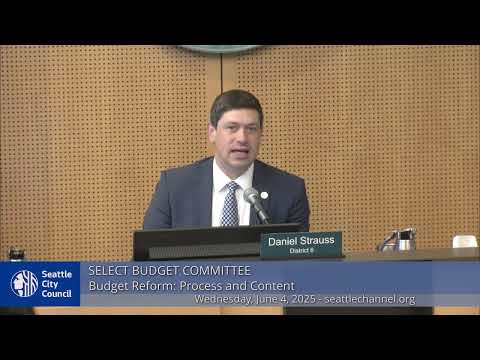
Chair Dan Strauss of the Select Budget Committee opened a June 5 meeting with central staff to preview changes to the council’s fall 2025 budget process, including earlier public access to member proposals and a tighter calendar to complete final action by Nov. 21.
The preview matters because the mayor will transmit the proposed budget on Sept. 23, and the committee is scheduling a compressed review and voting period tied to the city’s revenue forecasts and election timeline. Ben Noble, central staff director, said the council’s review calendar will include an October revenue forecast update that will inform the chair’s balancing package and final council votes.
Central staff described these scheduling changes as aimed at making deliberations and potential amendments visible to the public and to fellow council members earlier in the process. Noble told the committee that central staff intends to “publish those 24 hours in advance” for council member amendment lists and to post a public tool showing viable amendments that have the required sponsors.
Key dates and mechanics described at the briefing: - Mayor transmittal of the budget: Sept. 23, consistent with state law requiring transmission 90 days before year-end. - Revenue forecast update: Oct. 20 (sets revenues available for deliberations). - Initial public hearing and department presentations are scheduled in the weeks after transmittal; an early public hearing was noted by staff as taking place on the 7th (as described in the presentation). - Council-member proposal discussion: Oct. 28–30 (an initial public phase for members to present nascent proposals publicly). - Chair’s balancing package: expected to be released Nov. 5, with a follow-up public hearing and final committee votes the week of Nov. 14 and Nov. 17; final council action scheduled for Nov. 21. - Sponsorship rule: council amendments will generally require three sponsors; central staff said it will verify co-sponsor names before publication to avoid unintentional attribution.
Committee members asked staff about the tight turnaround between the chair’s package and the deadline for self-balanced amendments. Noble and Chair Strauss said the calendar is constrained by fixed forecast and election deadlines but that members will generally have several days (including individual meetings on Nov. 3) to confirm how their proposals were handled before public release. Noble also said central staff will allow members to register support via electronic hand-raising and then confirm sponsorships.
Committee members asked that the central staff post the chair’s balancing package as early as possible and that staff be available to answer questions immediately after posting so members can prepare any replacement or self-balanced amendments. Council member Kettle and Council President Nelson both emphasized the value of the expanded “look back” (a 5–6 year budget comparison) and requested that staff schedule a separate briefing when that document is complete.
Central staff also flagged several items that will feed into the fall process: an updated six-year budget look back (staff aim to complete it before the fall process), an analysis of programs available to employees subject to layoff (results due June 11 and planned for presentation June 18), and online tools for public visibility of amendments. Noble said central staff will publish the chair’s balancing package 48 hours before the second public hearing “to the greatest extent possible.”
The presentation noted staffing transitions at central staff and said additional analysts will help manage agendas and amendment development. Council members urged that the calendar provide enough time for staff to craft technically accurate amendments and to avoid the last-minute “walk-on” amendments that previously caused technical errors.
Ending: Chair Strauss closed the process discussion by reiterating the goal of increased transparency and confirming staff would return with the 6‑year look back and other materials in upcoming briefings.