Get Full Government Meeting Transcripts, Videos, & Alerts Forever!
Get email alerts on the It Budget Broadband Municipal Id topic
No spam. Unsubscribe anytime.
Baltimore IT office outlines budget priorities: broadband expansion, municipal ID, 311 and cybersecurity
Summary
A committee staff member opened the hearing by instructing participants not to request or disclose sensitive details of the 2019 ransomware attack because it remains an ongoing federal investigation.
A committee staff member opened the hearing by instructing participants not to request or disclose sensitive details of the 2019 ransomware attack because it remains an ongoing federal investigation. The staff member said the committee is limited in what it can discuss about the attack and about specific system vulnerabilities.
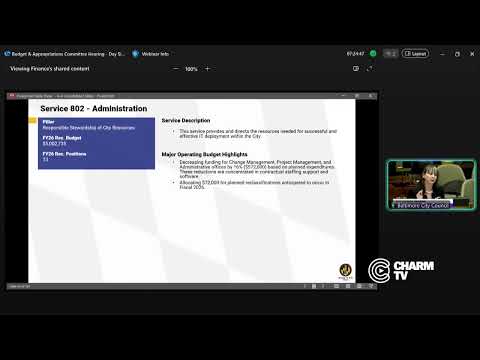
Interim Chief Information Officer Layla Layman presented the Baltimore City Office of Information and Technology’s budget and program priorities, telling the Ways and Means Committee the office’s mission is to “provide sustainable infrastructure and technology to support and enhance city agencies, communities, and businesses to meet city and mayoral goals.” She outlined eight service areas, including CityWatch camera monitoring, applications and Workday integration, 311, infrastructure and redundancy, broadband and digital equity, digital services, and a new municipal ID program.
Layman highlighted measurable improvements and specific program investments. She said the CityWatch camera network — more than 800 cameras — moved from roughly 88% availability in fiscal year 2022 to about 98% availability this year. The administrative services division includes fiscal, HR and project teams and will lead contractor conversions tied to FY26 savings; Layman said the office’s internship program will grow from six interns in FY24 to 15 the next summer. On applications, she cited 20 automated processes built in Workday, improved banking and settlement processes, and a partnership with the Department of Transportation, DGS and DPW to implement the Unifier enterprise project controls platform for capital programs.
On constituent services, Layman said 311 has taken more than 500,000 calls as of April (cumulative) and recorded over 41,000 calls year‑to‑date; the city plans to expand the call center to handle the plans‑examining phone line and to roll out a public 311 dashboard and additional language options, starting with Spanish. In infrastructure, BCIT reported nearly 90,000 IT service requests last year with a 95% satisfaction rate for ticket resolutions and has used ARPA funds to deploy hybrid meeting rooms, mobile solutions, and PC/network refreshes. The office also reported progress on disaster‑recovery plans and 800 MHz radio redundancy.
On cybersecurity, Layman said staff run phishing tests and awareness training and have reduced repeat clickers by 73% year over year. On broadband and digital equity — an ARPA‑funded initiative — Layman said Baltimore has distributed about 49,000 Chromebooks through partnerships with Enoch Pratt Free Library and others, made multimillion‑dollar investments in middle‑mile fiber, and awarded $1,800,000 in a second round of digital equity fund grants to 10 organizations plus $2,000,000 to an organization referred to in the transcript as “waves” to provide free internet to 24 multi‑dwelling units. The transcript also records that 33 Baltimore‑based organizations have received digital equity fund awards since 2023.
Layman announced a released request for proposals to bring a new internet service provider that would connect more than 45,100 public housing units to high‑speed service using the city’s fiber; she said by the end of fiscal year 2026 all eight public housing complexes should be ready for the ISP to provide service at under $50 per month. On a new municipal ID program, Layman said the Scott administration allocated $1,300,000 to fund six staff positions, marketing, equipment and software; the director position had been posted and additional roles were expected to be advertised.
Layman closed by acknowledging the work ahead on modernization and security and by asking council members to help recruit businesses to offer incentives for municipal ID holders so the program “does not become a second class ID.” Councilmembers responded with appreciation for the municipal ID initiative and follow‑up questions about permits and remediation; no formal votes occurred on the budget presentation during the hearing.
Ending: Layman and BCIT staff said they will continue working with partner agencies, the Tiger team and vendors to implement fixes and deliverables and will provide follow‑up materials requested by the committee.