Get Full Government Meeting Transcripts, Videos, & Alerts Forever!
Get email alerts on the Youth Programs topic
No spam. Unsubscribe anytime.
Council presses MOED on YouthWorks funding, equity and assumed Youth Fund allocation
Summary
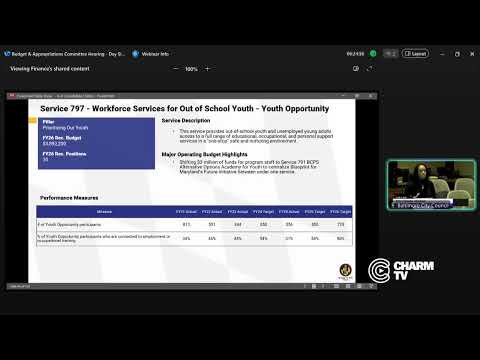
Baltimore City Council members pressed the mayor’s Office of Employment Development about YouthWorks funding and equitable distribution of summer jobs after Director Matt Garvin said the FY26 budget assumes $4.8 million from the Youth Fund while the Youth Fund board has approved $3.9 million.
The mayor’s Office of Employment Development told the Baltimore City Council on Oct. 11 that the FY26 budget assumes $4.8 million will be drawn from the city’s Youth Fund for youth programs, though the Youth Fund board has approved $3.9 million to date, prompting council members to demand clearer protocols and an equitable distribution of YouthWorks slots.
Council President Cohen opened the questioning by praising MOED’s work and asked for clarity on how much of the Youth Fund will support YouthWorks. Director Matt Garvin said the budgetary figure is an assumption and that “following adoption of the budget, we would have to work with the board to finalize the amount that's available for fiscal 26.”
Why it matters: YouthWorks is Baltimore’s largest summer jobs program. Council members said discrepancies between the budget assumption and the Youth Fund board allocation risk creating confusion during budget implementation and hamper oversight. Council members also pressed MOED on whether summer job slots are being distributed equitably across council districts, naming low participation in the Eighth and Ninth districts as a concern.
Most important facts
- Budget numbers: Garvin said the fiscal 2026 budget assumes $4,800,000 from the Youth Fund; he told the council the Youth Fund board’s recent prior approvals total $3.9 million and that the administration will finalize the amount with the board after the budget is adopted. (Budget assumption vs. board allocation was discussed in the hearing.)
- YouthWorks scale and timing: Garvin said YouthWorks will run July 8–Aug. 9 and pay $15 per hour. He and MOED staff reported that last summer about 9,136 young people were employed and that roughly 13,000 completed YouthWorks applications were submitted this year.
- Fundraising and funding mix: Garvin said MOED raises a large share of YouthWorks funding and that since FY16 about 75% of YouthWorks funding on average has come from money raised by MOED or other non‑city sources (state, federal, philanthropic). He said the office supplements city budget allocations by working with state partners, foundations and employers.
Council concerns and MOED responses
Council President Cohen and other council members said the council needs clearer procedures for how Youth Fund allocations are assumed in the budget and how the Youth Fund board approves distributions. Garvin acknowledged the discrepancy between the budget assumption and the board approval and said the administration and the board will finalize available funds after budget adoption.
Council members also pressed MOED on equitable access. Garvin and Denise Brown, assistant director and chief of youth services, described MOED’s outreach: automated online registration, text and email blasts, in‑school and rec‑center presentations, Saturday registration during March and spring break access, and the presence of ‘blueprint’ career coaches embedded in schools. Brown said staff begin outreach in late November or early December to every middle and high school and that blueprint career coaches placed in schools have helped increase registrants.
Requests and next steps
Council members made formal committee requests: to break out YouthWorks budgeting between summer and year‑round slots and to provide a district‑level list of community partners and worksites so council members can promote opportunities and track equity. Garvin agreed to provide those breakdowns and to continue working with council offices on targeted outreach.
Context and limitations
Garvin emphasized that much of MOED’s YouthWorks funding is not city general fund money and that MOED has a history of supplementing the program through negotiated state and philanthropic support. He also said YouthWorks administration relies heavily on nonprofit partners and a small number of general‑funded MOED staff backed by temporary and contracted staff.
Ending
Council members said they will follow up with MOED and the Youth Fund board to reconcile the budget assumption with the board’s allocation and to monitor district‑level participation, particularly in West Baltimore and the Eighth and Ninth districts.