Get Full Government Meeting Transcripts, Videos, & Alerts Forever!
Get email alerts on the Planning Department Budget And Programs topic
No spam. Unsubscribe anytime.
Baltimore Planning Department outlines FY26 priorities, staffing and neighborhood programs
Summary
Director Chris Ryer told the City Council budget committee that the Department of Planning is nearly fully staffed, will implement the recently adopted comprehensive plan, and highlighted neighborhood programs funded or run through the department including CleanCorps and food security grants.
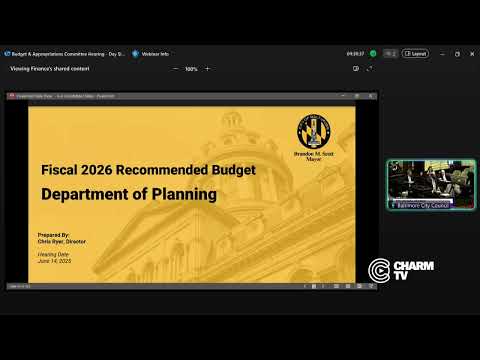
Chris Ryer, director of the Baltimore City Department of Planning, presented the department's FY26 operating priorities at a council budget hearing, saying the department is “almost fully staffed” and detailing programs and funding the department manages.
Ryer said the department will begin implementing recommendations of the recently completed comprehensive plan and will integrate the zoning administrator's office — previously housed in the Department of Housing and Community Development (HCD) — into Planning. “We are eagerly accepting the move of the zoning administrator's office from Department of Housing Community Development into the Department of Planning,” Ryer said. He described the change as a move to “place the team that writes the zoning code … with the team that interprets the zoning code.”
Why it matters: the integration is intended to streamline land-use review and improve coordination between code interpretation and permitting, which Planning officials said should make the city's development review process more predictable and responsive.
In his summary of recent activity, Ryer said Planning has distributed more than $10,000,000 to two dozen neighborhoods affected by the racetrack and casino and allocated more than $5,500,000 in the past two years for food security and urban agriculture. He also said the department has identified $7,000,000 to support acquisition, design and construction of the Green Network trail next year. “We also distribute over $10,000,000 in 2 dozen neighborhoods impacted by the racetrack and the casino,” Ryer said. “We've distributed over 5,500,000 in the past 2 years for food security and urban agriculture … and we have identified $7,000,000 to support the acquisition design and construction of the green network trail next year.”
The presentation described Planning's seven services (land use and urban design; CHAP/historic preservation review; comprehensive planning and resource management; sustainability and food policy; administration; and the new office of the zoning administrator) and performance goals tied to each. Ryer listed performance targets such as 30-day reviews of complete zoning applications and expedited reviews for planning commission matters, and noted technical challenges with the city's permitting system that affect turnaround times.
Division chiefs attending the hearing included Assistant Director Nicole Stewart; Jeff Wingvale, the zoning administrator; Chad Hayes, director of the Community Planning Division; Tara Lefebvre, chief of food policy and planning; Ava Richardson, director of the Office of Sustainability; and Treston Coddington, CleanCorps operations director, among others. Nicole Stewart said the department has added communications and equity staff and is building an engagement strategy tied to comprehensive-plan implementation, including a proposed comp plan advisory board and digital outreach tools.
Discussion vs. decision: the hearing was a presentation and Q&A; no formal votes or budget outcomes were recorded during the session. Council members asked about implementation, outreach and program continuity; Planning officials provided status updates and described next steps for internal coordination and outreach.
Ending: Planning staff said they are available to answer more detailed questions and will continue work on implementing the plan and testing changes to land-use processes.