Get Full Government Meeting Transcripts, Videos, & Alerts Forever!
Get email alerts on the Hiv Aids Education topic
No spam. Unsubscribe anytime.
Missoula internist urges sustained HIV/AIDS education, cites rising local and national cases
Summary
Dr. Tom Roberts, a Missoula internist, told School District No. 1 staff and community members that HIV/AIDS remains a growing public‑health problem, reviewed national and Montana data, explained transmission risks and treatments, and urged prevention through school-based education.
Dr. Tom Roberts, a Missoula internist who treats AIDS patients, told School District No. 1 staff and community members that HIV/AIDS is "truly a matter of life and death" and urged sustained education and prevention efforts while reviewing local and national data on cases, transmission and treatment.
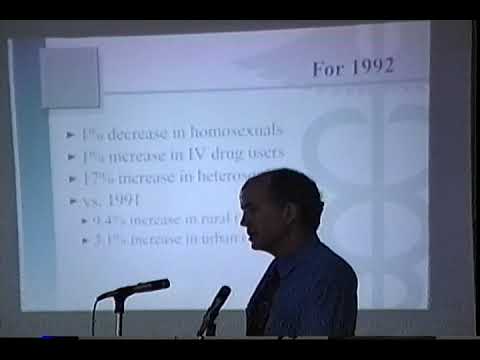
Roberts said the epidemic is not confined to large coastal cities and described rising heterosexual transmission and cases in rural areas. He reviewed national and Montana statistics, outlined how HIV attacks the immune system and summarized prevention and treatment options, emphasizing that prevention through education remains the most effective public‑health response.
Roberts framed the presentation around the scale and trajectory of the epidemic and why the schools should remain engaged. "We're embarking upon our continued education in what in my judgment is truly a matter of life and death," he told the audience. He said school‑based education can change behavior and urged repeated, accurate instruction so students develop safer lifelong habits.
On the scope of the epidemic, Roberts cited national figures and state counts: he said national cumulative reporting (as cited in his presentation) stood at "369" cases as of the end of 1993 with about 220,000 deaths, and he said Montana had recorded 212 cumulative AIDS cases, with 148 of those developing while the persons lived in Montana. He also said public‑health anonymous testing in Montana had returned roughly 400 positive HIV tests in state testing programs and that the true number of infections in the state was unknown.
Roberts described who is being affected. He said cases in Montana had been predominantly male and concentrated in population centers such as Billings, Missoula and Great Falls while also appearing in rural counties, including Lake County. He said the age group most affected is people 30–39 and that many who develop AIDS in their 20s likely contracted HIV as teenagers.
On how HIV spreads, Roberts said sexual contact remains the primary route and described transmission risks cited in published studies: in developed‑country heterosexual contacts he summarized risk at roughly 1 in 1,000 per exposure, while he cited much higher per‑contact risks reported in some studies from Thailand (about 1 in 30) and Nairobi (as high as 8 percent with a single contact with an infected sex worker). He also reviewed risks from contaminated needles, mother‑to‑child transmission (he cited about a 1 in 4 risk without interventions) and the rare risks to health‑care workers from needle sticks, which he described as roughly four infections per 1,000 needle sticks in the context he presented.
Roberts reviewed clinical effects of HIV and AIDS, explaining that the virus infects CD4 helper T cells, causes their gradual decline over years and leads to a range of opportunistic infections and cancers such as Kaposi's sarcoma and Pneumocystis pneumonia. He described common complications clinicians see, including persistent diarrhea, neurological symptoms and multiple opportunistic infections, and he said treatment options that exist (for example, AZT and other reverse‑transcriptase inhibitors, and prophylaxis for specific infections) can prolong life but are not curative.
On prevention, Roberts said abstinence and monogamy with an uninfected partner are the only completely safe options and that condom use substantially reduces—but does not eliminate—risk. He reviewed published laboratory and epidemiologic findings on condoms, noting that despite laboratory studies showing microscopic leakage in some conditions, condom use is ‘‘at least 10,000 times better than not using a condom’’ according to the paper he cited in his talk.
Roberts urged repeated, accurate school education about HIV and described data he reviewed on Montana students: he cited that roughly half of Montana high school students reported ever having sex and that condom use at last intercourse was about 55 percent in his slide references. He said school‑based instruction reached many students and that education can produce measurable behavior change analogous to early interventions for seat‑belt use or smoking.
During a brief question period Roberts said confidential HIV testing is available through the health department (which he said offers anonymous testing at no cost) and that clinic testing typically carries a fee (he cited about $35 at a clinic). He closed by reiterating that prevention through education is currently the most effective public‑health tool available against HIV/AIDS.
The presentation included a question‑and‑answer period; audience members asked about window periods for testing, blood‑supply safety, and the advantages of early detection. Roberts said antibody tests detect prior exposure and that most people develop antibodies within three months; he noted a small residual risk that very recently infected donors could be missed by screening and reiterated the comparative safety of today’s blood supply compared with earlier years.
The event was presented to School District No. 1 staff and community members; Roberts recommended continued school engagement on HIV education and public‑health resources for testing and counseling.