Get Full Government Meeting Transcripts, Videos, & Alerts Forever!
Get email alerts on the Middle Housing topic
No spam. Unsubscribe anytime.
Council advances interim middle-housing ordinance, adds volcanic-hazard exemption near hillsides
Summary
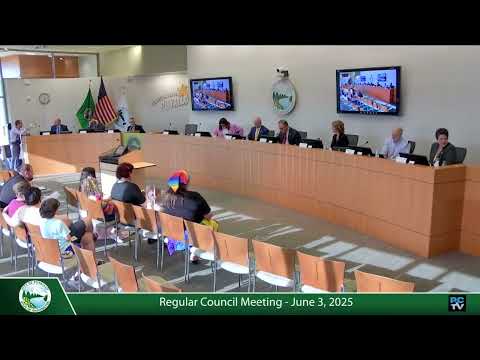
The Puyallup City Council approved first reading of an interim zoning ordinance to comply with state middle-housing requirements (House Bill 1110) and adopted an amendment exempting lots within a half-mile walk of the base of surrounding elevations from a volcanic-hazard restriction tied to lahars.
The Puyallup City Council on June 3 approved first reading of an interim zoning ordinance to implement state middle-housing rules from House Bill 1110 and voted to exempt lots within a half-mile walking distance of the base of surrounding elevations from a proposed volcanic-hazard restriction.
Why it matters: the state law requires cities to allow several types of “middle housing” (duplexes, triplexes, fourplexes and similar small multiunit types) in single-family residential zones to increase housing choices. The council’s action creates interim standards that must be in place before the June 30 statutory deadline and includes a locally negotiated exception for volcanic hazard areas after debate about evacuation logistics in the valley.
Katie Baker, senior planner, summarized the state requirement and the city’s interim approach, saying: “This is an interim zoning that we're requesting council take action on, so that we can get, compliant middle housing regulations in place prior to the June 30 deadline.” The draft would allow two middle-housing units per lot in RS zones and permit up to four units near the Sounder station or when one unit is designated affordable, Baker said. It sets objective design-review rules and parking bands tied to lot size: one off-street space per unit on lots under 6,000 square feet and up to two spaces per unit on larger lots.
Discussion centered on whether lots inside mapped volcanic-hazard areas should be treated differently. City staff’s interim draft offered two options: (A) no exception for volcanic hazard beyond existing critical-area rules; or (B) apply the critical-area exception plus a limited carve-out for volcanic hazard areas as defined in Puyallup’s critical-areas code. Council member Johnson moved an amendment to option B to exempt parcels that are within a half-mile from the base of surrounding elevations on the Puyallup Valley floor. Johnson said the change was intended to “show fairness, safety and consistency” for properties close enough to reach higher ground on foot during an evacuation.
Council members discussed evacuation logistics and vulnerable populations. Mayor Jim Castemath and several council members described lahar warning systems and past evacuation exercises; the mayor noted recent federal and geological studies and said the USGS has estimated a nonzero chance of lahar activity within planning horizons. Council members and staff repeated concerns about evacuation of residents in assisted-living and multiunit properties. The mayor said the city has lahar sirens in the valley and referenced previous large-scale drills that tested school evacuations.
The council approved Johnson’s amendment (half-mile exemption) by voice vote; the amendment passed 6–1. The underlying first-reading motion for the interim zoning ordinance — as amended and moving forward toward a required public hearing and possible second reading — passed on first reading 5–2. Under the interim schedule, staff told council the ordinance would be adopted for six months and staff will return with a permanent code after public engagement and Planning Commission review.
What was not decided: staff confirmed the interim ordinance does not change existing allowances in the city’s RM-20 multifamily zones or riparian/critical-area prohibitions for wetlands or streams; it focuses changes in RS (single-family) zones as required by the state law. Council members repeatedly said a longer-term study of evacuation capacity, transportation chokepoints on neighborhood streets, and assisted-living facility evacuation plans belongs in the broader comprehensive-plan and emergency-preparedness work the city is conducting.
Next steps: staff will schedule the ordinance for a public hearing (anticipated July 1), return for a second reading (anticipated June 17), and continue community outreach and Planning Commission review to craft a permanent ordinance that replaces the interim rules.
Ending: Council members said they expected further public input and more detailed analysis of evacuation and infrastructure capacity during the permanent-code process. The city’s interim action puts Puyallup on the state’s compliance timeline while preserving a narrowly drawn safety exemption for lots close to higher ground.