Get Full Government Meeting Transcripts, Videos, & Alerts Forever!
Get email alerts on the Complete And Green Streets topic
No spam. Unsubscribe anytime.
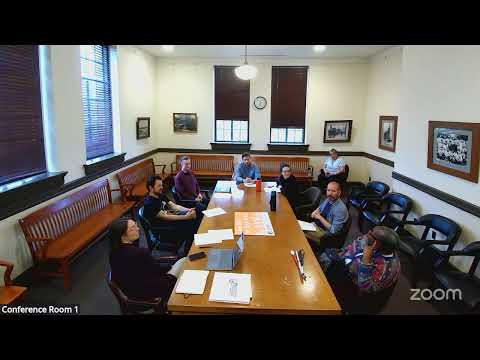
Kingston committee hears Madison lessons on Complete and Green Streets, Vision Zero and snow‑clearing
Summary
Grant Foster, a former Madison Common Council member, told Kingston’s Beach Streets committee that Madison overhauled transportation by creating a Department of Transportation, adopting a Complete and Green Streets policy and pursuing a Vision Zero safety goal.
Grant Foster, a former Madison Common Council member, told Kingston’s Beach Streets committee that Madison overhauled transportation by creating a separate Department of Transportation, adopting a Complete and Green Streets policy and pursuing a Vision Zero safety goal.
“Vision 0 … allowed us as a community to start grappling with the reality of traffic violence and, really allowed us to prioritize safety, above things like motor vehicle throughput,” Foster said, summarizing the policy shift he helped push in Madison.
Foster said Madison consolidated several advisory bodies into a single transportation commission with greater authority, hired a director of transportation to provide leadership beyond traffic engineering and developed street typologies to guide design choices. The Complete and Green Streets framework, he said, gives staff and engineers a starting point when reconstruction or major repairs occur so projects do not simply recreate the old street layout.
Foster described two program-level tools Madison used: a capital-first approach that treats full street reconstruction as the primary opportunity for lasting changes, and a Safe Streets Madison program that prioritizes smaller, interim safety projects for streets that will not be reconstructed soon. “We developed a kind of a system to essentially give points … we throw it all into 1 big program and focus at trying to do the biggest bang for our bucks,” he said.
Committee members pressed Foster on implementation details. He said the transportation commission recommends which projects from a staff‑maintained, prioritized list receive funding from a pot approved annually by the common council. Staff price estimated treatments, assign points, and the commission selects the final cut after public comment. Foster noted scale differences: Madison is about a quarter-million people and manages “maybe 2,700 lane miles” of streets, while Kingston is much smaller, so the pace and scale of work differ.
Winter maintenance and bicycle-path clearing were recurring topics. Foster said Madison addressed staffing and equipment by funding overtime and buying targeted equipment that could both clear bike paths and serve other maintenance functions. “We were able to get in that same budget amendment … here’s the money we need for overtime … and we also wanna get 1 new, piece of equipment,” he said, describing the combined funding-and-equipment solution.
Foster also described equity changes to traffic‑calming selection: rather than a complaint‑driven speed‑hump program, Madison reweighted criteria toward safety and access for walking, biking and transit and aimed to reduce the “squeaky wheel” effect that favored better‑resourced neighborhoods.
Kingston committee members asked about governance. Foster said Madison’s transportation department and public‑works engineering remained distinct but collaborated closely: engineering handles reconstruction and utilities while the transportation department focuses on planning, traffic, transit and parking. He emphasized the need for staff “vocal support” and clear direction from elected leaders so designs have political backing during neighborhood outreach.
The committee discussed next steps, including reviewing Kingston’s street typologies, examining whether a separate transportation lead is needed, and exploring short‑term programs focused on safety improvements and winter maintenance. Foster offered to be available for follow‑up questions.