Get Full Government Meeting Transcripts, Videos, & Alerts Forever!
Get email alerts on the Moderate Income Housing Reporting topic
No spam. Unsubscribe anytime.
Utah outlines 2025 Moderate Income Housing report process, deadlines and compliance rules
Summary
The Housing and Community Development Division (HCD) of the Utah Department of Workforce Services released a walkthrough for the 2025 Moderate Income Housing (MIH) annual report covering submission steps, deadlines, statutory references, review and appeal timelines, penalties and resources for municipalities and counties required to report.
The Housing and Community Development Division of the Utah Department of Workforce Services released a recorded walkthrough of the 2025 Moderate Income Housing (MIH) annual report process, telling municipalities and counties how to submit reports, meet statutory requirements and appeal determinations.
The guidance said the MIH annual report portal opened May 1 and that the report is due Aug. 1 at 11:59 p.m.; late reports will not be accepted. “If you did not receive the link on May 1, please reach out to us at mihutah.gov,” a division presenter said.
The walkthrough matters because state compliance affects eligibility for certain state transit funding and noncompliant jurisdictions face daily monetary penalties and ineligibility for those funds. The division also described changes made by the Utah Legislature this year in House Bill 37 that alter how some new MIH strategies count toward compliance.
Key submission steps and technical requirements: the report is hosted in Qualtrics and was sent by link to each municipality and county required to report. The presenter said the survey requires a valid email format and a 10-digit phone number, and that respondents should use the same browser and computer to resume a saved report. Jurisdictions must upload zoning shapefiles or provide web links to maps and tables using the Virtru secure file-sharing tool; after successful upload, respondents should type “uploaded” in the report field that requests shapefiles.
Reporting content and dates: communities must report entitled-unit data as of May 1, 2025, the presenter said; the first entitled-units question is required and five additional entitled-units questions are optional. The reporting period for actions on MIH strategies is Aug. 1, 2024, to July 31, 2025. The walkthrough also covers accessory dwelling units (ADUs) and other MIH strategies listed in Utah Code §10-9a-403 (municipalities) and Utah Code §17-27a-403 (counties).
House Bill 37 changes: the division summarized the effect of House Bill 37, saying the bill creates new MIH strategies that receive counting advantages. According to the walkthrough, a municipality without a fixed guideway transit station that uses one of the new strategies counts that single strategy as three for compliance for the base year and two subsequent reporting years. A municipality with a fixed guideway station can meet compliance with at least three strategies instead of five. For counties, using one of the new strategies allows them to meet compliance with one strategy instead of three and be considered compliant for the base year and two subsequent reporting years. The presenter defined a fixed guideway transit station as a public transit facility that uses rail or a separate right of way for transit, citing TRAX and FrontRunner as examples.
Review, correction and appeal timelines: after submission the division has 90 days to review and determine compliance or noncompliance. If a report is noncompliant, jurisdictions may submit a corrected report within 90 days of the notice; the division will review corrected reports within 30 days. To appeal a Notice of Noncompliance, a jurisdiction must submit a written request within 10 days of the notice that includes the community’s name, a representative’s signature and reasons for the appeal; the division will form an appeal board and jurisdictions may submit additional information within 15 calendar days related to the reporting period or compliance strategy. If a jurisdiction withdraws an appeal less than seven days before the appeal board’s first meeting, the jurisdiction still must correct the deficiency within the original 90-day correction period.
Penalties and funding consequences: the walkthrough said jurisdictions that do not submit a report or remain noncompliant after correction or appeal lose eligibility for various state transit funds and face monetary penalties of $250 per day in the first year of noncompliance and $500 per day in the second year.
Support and resources: the division directed reporters to a Frequently Asked Questions page and to jobs.utah.gov/mihreporting for detailed instructions and prior reports. The presenter pointed to the Utah Housing Affordability Dashboard — developed with the Kem C. Gardner Policy Institute — for county- and municipality-level housing metrics (available for places with populations over 5,000). The walkthrough also listed practical instructions for using Qualtrics and Virtru and provided a contact for additional help: Meg Ryan at the Utah League of Cities and Towns.
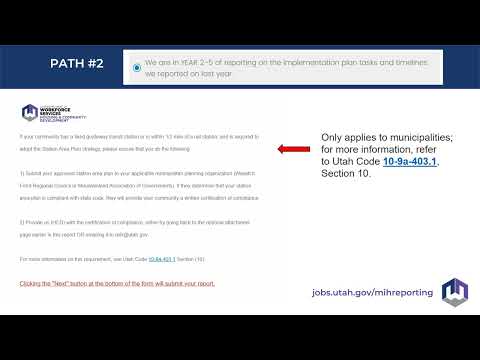
The division emphasized technical points that affect submission: once a reporter chooses certain survey-path options (for example, answering “No” to adding another strategy) the survey prevents going back, and mistakes on that choice must be fixed by contacting HCD. The presenter reminded jurisdictions that if they have a fixed guideway transit station or are within one-half mile of a rail station and are required to adopt a Station Area Plan strategy, the survey will outline specific additional steps to follow.
The division encouraged jurisdictions to attach adopted resolutions or ordinances related to amended MIH strategies and to include benchmarks and implementation timelines for each strategy reported. A copy of each submission is emailed to the contact address entered at the start of the report.
For assistance the division repeated its general contact: mihutah.gov and the FAQ page at jobs.utah.gov/mihreporting.