Get Full Government Meeting Transcripts, Videos, & Alerts Forever!
Get email alerts on the Pensions And Benefits topic
No spam. Unsubscribe anytime.
Enterprise officials consider restoring Tier 1 retirement benefits for city employees
Summary
City staff presented options to the Enterprise City Council on restoring RSA Tier 1 retirement benefits citywide, recommending adoption of two state acts; council members voiced support and directed staff to prepare ordinance language for a near-term vote.
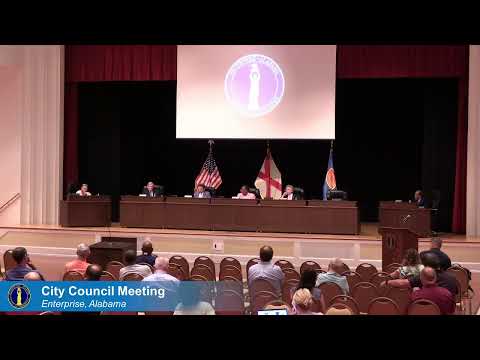
City staff and elected officials discussed whether to restore Tier 1 retirement benefits for city employees during the Enterprise City Council meeting on June 9, 2025.
City staff recommended adopting two state acts that would permit Tier 2 employees to receive Tier 1 benefits. The recommendation calls for the council to enact both acts, which staff said would change employer and employee contribution rates and require secondary steps before the change would take effect.
Mister Tullis (city staff) summarized timing and process, saying the city would need to submit paperwork to the Retirement Systems of Alabama (RSA) in August if the council chose to act now and that detailed actuarial work and formula changes would be required. “Unless an action is taken within the next 6 weeks … it’ll be moot until FY2027,” he said.
Allison Love, the human resources director, and Leanne Schwartz (city CFO) walked council members through a benefits comparison showing the differences between Tier 1 and Tier 2 for law enforcement/fire/correctional employees and for regular employees. The presentation noted differences in retirement eligibility ages, multiplier factors (2.0125% for Tier 1; 1.65% for Tier 2), salary averaging (highest three years for Tier 1; highest five of last ten for Tier 2), sick-leave conversion, and caps on benefits.
Staff provided current employee counts used in the analysis: 16 employees classified as Tier 1 and about 200 classified as Tier 2, for a total headcount of 316 city employees (the figures include the water department for completeness, staff said). Staff cited the RSA actuarial valuation as of Sept. 30, 2023, noting the city’s funded ratio at the end of 2023 was 71.6 percent and that the actuarial “estimate of the long-term liability” was just over $47,500,000 as of that valuation.
Staff described near-term contribution-rate scenarios. Using staff’s figures, RSA’s required city contribution rates for next year would change under different options: the packet showed the city’s Tier 1 rate rising from 10.7% to 11.49% and the Tier 2 rate from 7.63% to 8.37% based on RSA’s valuation; staff said that if the council adopted both acts under consideration, modeled rates could be about 9.9% for Tier 1 and 10.63% for Tier 2, and that adopting both acts would also increase employee contribution rates. Staff cautioned these were scenario estimates and that adopting Tier 1 benefits would raise the city’s long-term liability.
Mister Tullis said staff’s estimate of the increase in the city’s unfunded liability from converting would likely be larger than earlier estimates and could be “easily a million dollars,” noting a prior estimate four years earlier had been $635,000. He outlined options to address the liability, including a lump-sum payment, incrementally higher ongoing employer contributions, or other budget adjustments.
Council members, mayors and department chiefs who spoke generally supported moving the question forward. Councilmember Padgett and others said they lacked sufficient information four years ago but now felt more confident. Mayor Cooper said, “If we can afford to offer Tier 1 benefits, and I believe we can, we should do so.”
Fire Chief Davis and Police Chief Moore urged action on retention and recruitment grounds. Chief Davis said the department’s applicant pool had fallen sharply and that transfers to neighboring cities with Tier 1 benefits were a real retention pressure; he told council members, “100% of the tier ones said it was worth it.”
Staff’s recommendation was explicit: prepare ordinance and implementation materials to adopt both acts and present the measure for council consideration as soon as practicable (staff suggested introducing legislation at the next council meeting or in July, then laying it over for the required period before a vote). Council members signaled support for that approach; one councilmember said adopting both acts would be their preference.
No ordinance was adopted at the June 9 meeting; the council provided direction to staff to draft materials and return with formal legislation for future consideration.
Two items staff and council flagged for further work were (1) precise actuarial estimates of long-term cost under the chosen option and (2) the timing and structure of any employee-contribution increases if both acts are enacted.