Get Full Government Meeting Transcripts, Videos, & Alerts Forever!
Get email alerts on the K12 Budget Staffing topic
No spam. Unsubscribe anytime.
Eau Claire board approves level-for-level market increase for school‑year hourly staff after budget briefing
Summary
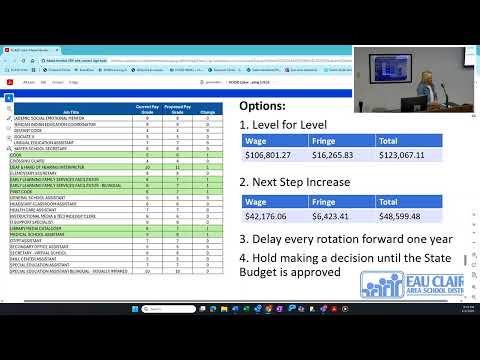
After a district budget briefing on staffing costs and enrollment trends, the Eau Claire Area School Board voted to approve a level‑for‑level market increase for school‑year hourly employees, with the change to be applied for the coming school year.
The Eau Claire Area School Board voted to approve a level‑for‑level market adjustment for school‑year hourly employees following a detailed presentation on district costing and budget risks.
The board’s vote adopted Option 1 from a set of market‑review options presented by district staff. The motion to approve Option 1 was made by Doctor Farrar and seconded by Commissioner Towle; the board recorded support from Commissioners Case, Dement, Farrar, Nordine and Towle and the motion passed.
The decision followed a lengthy presentation by Doctor Elworthy, a district staff member, who outlined the district’s approach to “costing” — an estimate of the additional salary cost if employees move one step on pay schedules — and warned that costing is a projection tool rather than a statement of what the district can definitively afford. Elworthy told the board that “costing has become even more important” as staff mobility and enrollment changes have increased year‑to‑year budget uncertainty.
Elworthy described key financial pressures facing the district: a decline in enrollment with associated revenue limits, the scheduled end of federal ESSER funds, increased staffing levels added in recent years, and a multi‑year timeline for sustaining referendum investments. He said the district is continuing to refine its costing methodology by testing school‑level payroll pulls and comparing modeled increases to actual payroll totals.
Board members who spoke said they weighed the risk of approving increases before the state budget is finalized against the risk of delayed action for lower‑paid employees. Commissioner Case said level movement is “the cost of doing business,” arguing the board should maintain market competitiveness. Commissioner Beeker and others urged caution but ultimately supported the motion.
Board members and staff noted that the district typically waits for the state budget before some other decisions (for example, CPI or cost‑of‑living adjustments), but moved forward on the school‑year hourly market change so those employees would know their pay status before summer.
The district’s administration said implementation timing would align with payroll processes so increases could take effect in the first pay period after the start of the school year. The board did not adopt other market options presented, including a pause or a delayed decision tied explicitly to the state budget.
The board’s action affects school‑year hourly employees only; broader collective bargaining groups and certified staff remain subject to separate processes and timelines. District staff said they will incorporate the approved market change into payroll and communicate details to affected employees.
The board also received an overview of longer‑term financial issues, including enrollment forecasts, revenue‑limit mechanics, and the need to prioritize sustaining referendum investments.
The board adjourned the agenda item after the recorded vote.