Get Full Government Meeting Transcripts, Videos, & Alerts Forever!
Get email alerts on the Entertainment Venue topic
No spam. Unsubscribe anytime.
BZA allows second‑floor music and event venue in Union Market, citing limited operation and design controls
Summary
The Board of Zoning Adjustment approved an applicant's request to convert two second‑floor spaces at 405–407 Moore Street NE into a private event and performance venue, granting both a special exception and a variance from the 1,000‑foot location rule while noting controls to limit noise and crowding.
BZA approves second‑floor performance venue near Union Market with conditions intended to limit noise, traffic and crowding.
The District of Columbia Board of Zoning Adjustment on June 4 granted Oak at Moore Street LLC permission to operate a new entertainment assembly and performing arts use across two contiguous second‑floor spaces at 405 and 407 Moore Street NE (application 21292). The board granted a special exception under Subtitle U Section 802 and an area variance from the 1,000‑foot location requirement that limits how close similar live entertainment venues can be to one another.
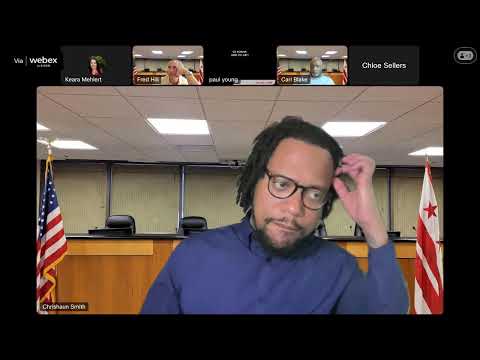
Vice Chair Carl Blake, who led deliberations on the application, said the applicant had provided supplemental materials including renderings and operational clarifications that persuaded him the use would not be "objectionable to neighboring property because of noise, traffic, parking, loading, the number of attendees, waste collection, or other objectionable conditions." He said the subject property would be used primarily as a private event space rather than a late‑night nightclub. "The subject property will serve as a private event space, so it will only be booked for private events on a regular or limited schedule," Blake said during deliberations.
The venue will operate on the second floors of two existing two‑story attached buildings in the PDR‑1 zone. The applicant stated the venue would have a maximum capacity of 240 persons, all performance would occur indoors, windows and exterior doors would be kept closed during performances and no external amplification was proposed. Access is from a rear alley; an open deck on Moore Street faces the sidewalk but a 16‑foot louvered roof will be set back behind a parapet so the rooftop equipment will not be visible from the street.
Board members noted the nearby 400 Moore Street establishment (which the record shows has live performance components) would differ in character because it is designed primarily as a restaurant with a regular operating schedule. The BZA determined the two venues were unlikely to operate at the same time with the same scale of activity, and that, even aggregated, the combined capacity of both sites would be smaller than major concert halls in the city.
On the motion made by Vice Chair Blake and seconded by board member Kershaw Smith, the staff recorded the vote as 3‑0‑2 to approve application 21292.
Why it matters: the decision allows a new mid‑scale event space in a PDR zone near Union Market while relying on operational limitations and design features to limit neighborhood impacts. The variance from the 1,000‑foot rule was granted in part because the board credited the Office of Planninganalysis and the applicantstated operational controls.
What happens next: the applicant must comply with the conditions recorded in the boards final order and obtain any required building and operational permits before opening.