Get Full Government Meeting Transcripts, Videos, & Alerts Forever!
Get email alerts on the Temporary Housing Shelters topic
No spam. Unsubscribe anytime.
Planning commission backs zoning change to allow temporary housing shelters in R‑3 and B‑3 with conditions
Summary
The Athens City Planning Commission voted unanimously to recommend that City Council amend zoning code language to allow temporary housing shelters in R‑3 and B‑3 zones as a conditionally permitted use, subject to Board of Zoning Appeals review and annual reapproval by the service safety director.
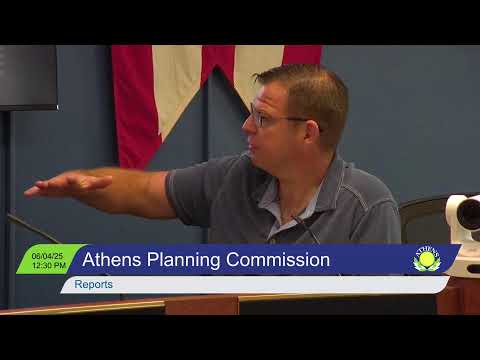
Athens City Planning Commission members voted unanimously June 4 to recommend that City Council amend Title 23 to permit temporary housing shelters in R‑3 residential and B‑3 general business zones, with review by the Board of Zoning Appeals and annual reapproval by the city’s service safety director.
The change, filed as case 25‑05, would list temporary housing shelters as a conditionally permitted use in the cited sections of the zoning code rather than as an administratively approved accessory use. Miss Jennings, a planning staff member, told the commission the proposed language moves the use to conditional status so “any application for this type of use will have to go to the VZA for review and approval, which does include a public hearing and public notification,” and that the service safety director would also review applications and reapprove them annually.
The move drew discussion about how the code language would be interpreted in practice. One commissioner pointed out that, because the proposed language makes the shelters conditionally permitted, the use could exist as a principal use on a vacant parcel if a conditional‑use permit were approved by the BZA. The commission debated whether that outcome was likely given a separate requirement in the draft that sanitation fixtures (toilet and sink) be within 200 feet of the shelter site.
Rob Delich, chair of the Board of Zoning Appeals and a city resident, asked whether the sanitation requirement implicitly requires plumbed restroom facilities or could be met by temporary, non‑plumbed units such as portable toilets. Delich said, “Toilet seems to imply plumbed to me, but I’m not sure if it is by definition here or not,” and noted that a prior approval on Union Street had relied on portable restroom facilities. Commissioners discussed that temporary or trailer‑style restroom setups could be acceptable so long as the service safety director deemed them adequate.
Delich also raised the BZA’s need for clearer guidance when evaluating conditionally permitted uses. He said the board often lacks explicit standards and must weigh neighborhood impacts on a case‑by‑case basis, which can make decisions feel subjective. Miss Jennings responded that providing detailed use standards can reduce flexibility and, if standards are too prescriptive, can effectively transform a conditional use into a permitted use that bypasses the public review the BZA is intended to provide.
The commission approved a motion that included a technical edit: removing a redundant final sentence in the two affected code subsections. A commissioner moved to approve the revised language for both Section 23.040.03 (R‑3) and Section 23.040.07 (B‑3) with the deletion, another commissioner seconded, and the motion carried by unanimous voice vote of the three commissioners present.
Next steps: the commission’s recommendation will be forwarded to City Council for its consideration. Miss Jennings said she and city staff will consult with legal counsel (Lisa Eliason was named as the law director to be consulted) to finalize any minor language adjustments; she indicated that if City Council approves substantially the same language, the amendment would not need to return to the Planning Commission.
The commission’s discussion left open two policy questions for subsequent review: whether the sanitation requirement should be defined to require plumbed facilities or allow portable units, and whether the code should include clearer criteria for BZA review of conditionally permitted uses. The transcript shows those questions were raised during the discussion but not resolved by formal amendment.