Get Full Government Meeting Transcripts, Videos, & Alerts Forever!
Get email alerts on the Sustainability Budget Cip topic
No spam. Unsubscribe anytime.
Salem committee approves sustainability operating budget; funding request for citywide flood model included in five-year CIP
Summary
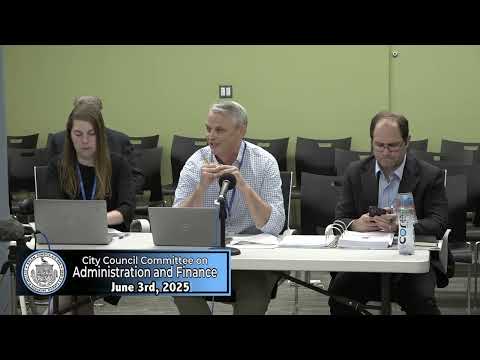
The Salem City Council Administration and Finance Committee on Tuesday recommended approval of the Sustainability and Resiliency Department’s FY26 operating budget and reviewed a capital request to develop a citywide hydraulic and hydrologic model to guide flood-mitigation priorities.
The Salem City Council Administration and Finance Committee on Tuesday recommended approval of the Sustainability and Resiliency Department’s fiscal 2026 operating budget and reviewed a capital request to develop a citywide hydraulic and hydrologic model to inform flood-mitigation priorities.
Neil Duffy, director of the Sustainability and Resiliency Department, told the committee the department has “4 full time, staff, including myself, and 1 part time admin” and that a UMass Lowell–funded fellow will join the team over the summer to add capacity.
The department presented a largely flat operating budget for FY26: staff levels remained unchanged and only small adjustments were proposed for training and in-state travel. The Administration and Finance Committee voted to recommend approval of the department’s personnel line of $265,053 and an expenditures line of $5,600, for a department total of $270,653; Councilor Stock made the motion and Councilor Harvey seconded. The motion carried.
Duffy outlined grant-funded work that will continue into FY26, including two Coastal Zone Management (CZM) coastal resilience grants for Collins Cove and Winter Island Park and a Municipal Vulnerability Preparedness (MVP) grant. He said the department expects other technical-assistance awards and smaller grants to support resiliency projects.
On the capital improvement plan, Duffy described a request for funding to support part of a full H&H model of the city to better understand how rainfall and other flows move through Salem. “We want to be able to better understand how that happens and where we should be focusing our efforts to try to mitigate the flooding that we experience,” he said, noting that state tools for coastal flooding exist but that a more holistic, citywide model is lacking. The request covers a portion of the model scope; Duffy said the department expects to combine the local appropriation with grant funding to complete the full scope.
Councilors asked how the model would be used. One councilor said the work should avoid “moving the flooding situation next to it” and described the need for comprehensive solutions. Duffy and committee members discussed how a citywide model can reveal upstream interventions that reduce downstream impacts, citing Worcester’s recent citywide H&H work as an example of how modeling can shift project priorities to non-obvious locations.
Duffy also briefed the panel on program-level tracking data the department has been collecting—such as counts of electric vehicle registrations and installations of air-source heat pumps—and cautioned that the figures have varying sources and margins of error.
The committee heard that Salem was recently designated a Climate Leader community, a status that made the city eligible for a $50,000 planning grant and up to $1 million in action grant funding for decarbonization projects. Duffy said the department will strategize this year about how best to use those funds.
What’s next: The recommended budget will move through the council’s remaining hearing schedule in mid-June; the H&H model funding request remains in the five-year capital plan pending confirmation of matching grant support.