Get Full Government Meeting Transcripts, Videos, & Alerts Forever!
Get email alerts on the Vending Ordinance topic
No spam. Unsubscribe anytime.
Salem committee refers rewritten vending ordinance after debate over fees, enforcement
Summary
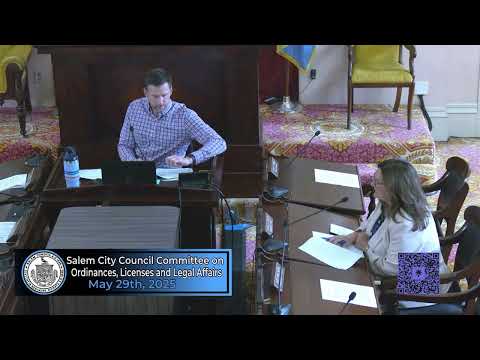
A committee of the Salem City Council on May 20 reviewed proposed amendments to the city's vending ordinance and voted to refer the measure to the full council with a positive recommendation.
A committee of the Salem City Council on May 20 reviewed proposed amendments to the city's vending ordinance and voted to refer the measure to the full council with a positive recommendation.
The changes, drafted by city staff after a grant-funded review of event policies, clarify who must be licensed, set application and per-vendor fees, codify site and ADA requirements, add enforcement steps and fines, and preserve a carve-out for farmers markets. Committee members debated whether the proposed fees fully cover city costs and whether organizers should pay more to cover cleanup and public-safety staffing.
"Creating transparent pathways, equitable access, and also enforceable regulations are really the the top 3 priorities in the in the recommended changes," said Julie Berry, Senior Planner for Arts and Culture for the City of Salem, describing the grant-led review behind the rewrite.
Under the draft ordinance, the city would charge a $110 application fee tied to licensing administration. Per-vendor charges are scaled: Salem-based vendors pay a smaller amount while out-of-town vendors pay more; staff described the current proposal as roughly $10 per vendor for local vendors and $20 per vendor for non‑Salem vendors for up to 10 vendors, with an additional $5 per vendor for each vendor above 10. Event organizers (the entity that applies for group events) would pay a single organizer fee rather than requiring each vendor to appear before the licensing board.
City staff told the committee that the $110 application fee is intended to cover roughly two hours of administrative processing by the licensing clerk and staff review time. Enforcement patrols are estimated at about one to 1.5 hours per inspection; overtime or additional enforcement for larger events can raise costs. The park department separately charges $25 per vendor for park events and requires a refundable security deposit for some spaces — staff cited a $250 refundable performance deposit for Derby Square that may be retained for property damage or trash removal.
The draft also codifies event requirements the city enforces now: 10-by-10 vendor spaces unless multiple spots are paid for; maintaining a four-foot accessible pathway for ADA compliance; displaying licenses; restrictions on certain canopy logos; and documentation requirements including health inspection reports, sales-tax registration and insurance. The ordinance requires organized events to notify the city roughly two months in advance.
Enforcement penalties in the draft are phased: a warning for a first violation, a $150 fine for a second violation, and possible permit revocation for repeated noncompliance. "Event organizers, the same thing if... they're not requiring their vendors to put up their sales tax information. We'll tell them again, you know, please make sure that you are compliant," staff explained to the committee.
The committee also discussed transient vendors (street vendors who operate outside of organized events). Staff said that transient vendors come with state licenses and the city issues laminated badges after a CORI check; the historic city fee for transient vendors has been $125. The draft proposes deleting a separate charitable-vendor provision (section 62). "We are proposing to delete the charitable section... because the anti aid amendment does not allow us to treat vendors differently based on your status," said Beth Renard, City Solicitor.
Council members raised competing concerns about fee levels. Councilor Jerslow said the proposed fees are too low and could leave taxpayers covering cleanup and police overtime, adding, "I just don't agree. I think the city is selling themselves out with these fees." Other councilors and staff said the ordinance is intended to cover administrative licensing costs and that larger event costs (police details, park damages) are handled separately through park fees, contracts or RFPs.
Councilor Jerslow moved to raise many of the proposed vendor fees (for example, increasing base vendor fees from $100 to $200 and organizer/out‑of‑town rates higher); the motion received no second and was not moved to a vote. The committee approved a housekeeping amendment to add an "s" to the word "organizer(s)" in section 28‑58 after a motion and second.
Councilor Cohen moved to refer the ordinance as amended to the full council with a positive recommendation; the motion was seconded by the chair and supported by the committee. The committee then adjourned.
The full Salem City Council will receive the ordinance and the committee's recommendation at a future meeting; staff said that organizers of large, park‑based events will still work with Parks & Recreation on separate fees and security deposits for property and cleanup costs.