Get Full Government Meeting Transcripts, Videos, & Alerts Forever!
Get email alerts on the Education Budget topic
No spam. Unsubscribe anytime.
Committee recommends $78.17 million FY26 Salem Public Schools budget; committee also reviews CIP requests
Summary
A City of Salem council committee recommended approval of the Salem Public Schools FY26 operating budget of $78,173,061, citing a 4.8% increase, a $4.9 million gap, 57 proposed position reductions and planned offsets including prepaying special-education tuition and recurring revenues; councilors also reviewed school capital-improvement requests.
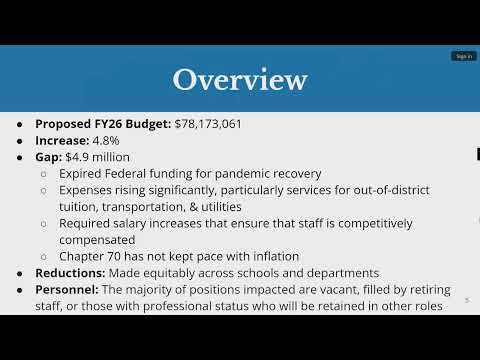
The City of Salem Committee on Administration and Finance on May 27 recommended approval of the Salem Public Schools proposed fiscal year 2026 operating budget of $78,173,061, a 4.8% increase over FY25.
The recommendation came after a presentation from school officials that described a roughly $4.9 million shortfall driven by higher personnel costs following a new contract for educators, rising transportation and utilities costs, and the expiration of federal pandemic funding. The committee voted to recommend the budget at the meeting; Councilor Stott moved the recommendation and Councilor Harvey seconded. The motion carried unanimously among members present.
Why it matters: the school budget is the largest single component of the city’s spending and funds core services from classroom staffing to special education and transportation. School leaders told the committee that personnel comprise about 76% of the district’s budget and that the district is prioritizing classroom-preserving choices despite the gap.
School leaders described the proposed FY26 budget as a response to a new teacher contract, retention needs and rising operating costs. The superintendent (identified in the meeting as the district’s chief executive) told the committee, “we entered this year knowing that it would be challenging because we had settled a new contract with our educators…we have a much more competitive salary schedule and our teachers deserve to be paid more competitively.” Assistant-level finance staff explained how state aid, local revenue and recurring offsets were applied to the request.
Major numbers and tradeoffs presented to the committee included: the $78,173,061 proposed appropriation (a 4.8% increase); an identified budget gap of about $4,900,000; 57 proposed position reductions (about 20 attributable to retirements/planned departures and about 15 positions shifted to other roles in the district); an enrollment of 3,958 students (about a 2% increase); and 942 students served in special education. School officials said roughly 76% of the budget is personnel and 24% is non-personnel expenses.
School staff described rising fixed costs as a principal driver. They told the committee they expect electricity costs to increase about 30% in FY26 (after prior-year increases), natural gas about 10%, and that out-of-district special-education tuition and homeless-student transportation have grown substantially; the presentation noted homeless-transportation spending budgeted at about $800,000 in FY25 and projected to exceed $1.3 million. Officials said they have invested in energy-efficiency measures such as lighting upgrades and building weatherization to reduce costs.
To close the remaining roughly $825,000 gap between the proposed expenses and available appropriation, staff said the district plans to prepay special-education tuition from current-year funds where allowed, move some staff costs onto grants and use recurring revenue sources (for example, Circuit Breaker reimbursements and lease/rental income such as from the Boys & Girls Club at Collins). Staff cautioned that the budget assumes the current status of federal pandemic-era funding and that any reductions in those revenues would change the forecast.
Committee members pressed on details. Councilor Cohen urged use of heat-pump technology in future capital work and highlighted the state Senate’s budget language proposing full funding of the Student Opportunity Act; staff replied that final state aid numbers remain subject to the House-Senate reconciliation and that the district’s formula-driven Chapter 70 calculation determines the local share. Councilors asked for greater clarity on which specific positions are reduced; staff pointed to pages 29–30 of the district budget book for a line-item list and said many of the reductions were vacancies or retirements and that, as of the meeting, no in-good-standing certified educator had been displaced.
The committee also reviewed school capital-improvement plan requests included in the five-year CIP. School officials described requests that include: a gym-floor replacement at Horace Mann; building painting and playground/field repairs including work at Bertram Field and track repairs; roof replacement at Bates Elementary (after selection for the MSBA Accelerated Repair Program, leaving an estimated local share of $988,000); HVAC, plumbing and controls work (including chillers and controls at Collins and Carlton); security and life-safety funds (elevator, fire sprinkler, access control, vape detectors and cameras); and technology replacement (Chromebooks, whiteboards, projectors and special-education devices). Staff also noted a generator replacement need at Bates and that some costs were higher than expected when facilities were surveyed.
Formal action and next steps: Councilor Stott moved that the committee recommend approval of the Salem Public Schools FY26 budget of $78,173,061; Councilor Harvey seconded. The chair recorded four affirmative hands and the motion carried unanimously among members present. School staff told the committee the full City Council is scheduled to take final votes later in the budget calendar (staff referenced a June 12 council action on the school budget and noted a June 11 council vote will address CIP funding sources).
What remains unresolved: staff flagged several contingent items, including the final Chapter 70 state aid numbers (House and Senate reconciliations were ongoing), the future of some federal funding streams, and the longer-term facilities/space strategy the school committee plans to study. School leaders said they will return with more detailed leases and utilization data as the school committee considers building consolidation and space optimization at a June 21 retreat.
The meeting record shows the district solicited public and staff input through two public forums, a staff-only forum, a formal April 14 budget hearing required by law and multiple advisory-group meetings. Staff said adjustments were made to the proposal based on that feedback and union negotiations.
The committee adjourned after the CIP review; councilors and school leaders thanked educators and staff for the presentation and work on the budget.