Get Full Government Meeting Transcripts, Videos, & Alerts Forever!
Get email alerts on the Solar Development topic
No spam. Unsubscribe anytime.
Planning commission recommends denial of Wilkinson family 281-acre solar CUP after lengthy public comment
Summary
On June 3 the Chino Valley Planning and Zoning Commission recommended denial of Conditional Use Permit CUP 2025-01 for a proposed photovoltaic solar facility with battery storage on Wilkinson family land, citing split views among commissioners and extensive public testimony; the recommendation will go to Town Council.
CHINO VALLEY, Ariz. — The Chino Valley Planning and Zoning Commission on June 3 voted to recommend denial of Conditional Use Permit CUP 2025-01, a proposal to build a photovoltaic solar array and battery energy storage system on roughly 281 acres of Wilkinson family land near 3245 Jerome Junction. The commission’s recommendation (four in favor of denial, two opposed, one abstention) will be transmitted to the Town Council, which has final authority.
Town planning staff summarized the application and regulatory history, telling the commission the proposal covers two parcels within a larger 642–690 acre ownership; staff said approximately 281 acres are proposed for the solar facility. Staff reviewed prior approvals and the town’s solar-ordinance process: an earlier CUP for the site expired without construction, a proposed change to the open-space district was not recommended by the commission in 2022, and the town later formed a staff solar advisory committee that drafted an ordinance that council did not adopt in March 2025. Staff said a neighbor letter prompted an expanded list of conditions for the current CUP and recommended the commission hold a public hearing and forward the case to council for decision.
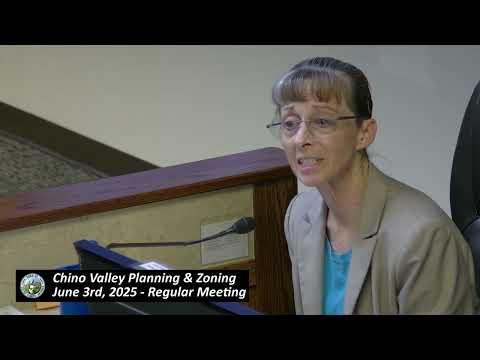
Sarah, a representative of Prospect 14 (the project developer), presented the Wilkinson Family Solar Project and described it as a 281-acre photovoltaic array with battery energy storage co-located adjacent to an APS substation. “It’s a low-impact passive use of the land,” Sarah told the commission, noting the project has a signed interconnection agreement that is "in suspension and in good standing." She said Prospect 14 seeks to provide lease income to the Wilkinson family and listed potential community benefits discussed at a neighborhood meeting, including Peavine Trail landscaping improvements, a possible pickleball court, and a pilot rainwater research project to evaluate collecting runoff from panels to recharge aquifers.
Sarah and other project speakers said the project would generate property-tax revenue for the county and the Chino Valley Unified School District; a tax analysis provided by the applicant’s consultant estimated roughly $4 million to $5 million in school-district revenue over the project life (the applicant said that estimate was calculated over a 25-year horizon and could be updated). Sarah also said the typical land-lease term would be 25 to 40 years, with options that could take operations to as much as 40 years.
Commissioners and residents raised multiple concerns during the public hearing. Opposition speakers cited potential impacts on property values and viewsheds, road wear from heavy construction traffic, long-term changes to the landscape and rural character, and fire risk related to battery storage. Paul Hawksworth, a neighboring property owner, said he and other nearby residents remained uncertain about glare, setbacks and viewshed effects: “We have no idea what a view shed analysis is,” Hawksworth said. April Durney, who lives across from the site, said she feared increased traffic and lost scenic views. Several commenters urged the commission to secure direct fiscal benefits for the town; speakers noted that the town does not levy property tax and local tax revenue typically flows to the county.
Supporters told the commission the project would advance local renewable-energy goals, respect private property rights, and offer economic benefits. A letter read into the record by a supporter from Arizonans for Community Choice recommended the CUP, saying the project "will have minimal environmental impact, use minimal water ... and is less expensive per kilowatt hour than fossil fuel energy." Former state official Andy Tobin, speaking in his private capacity, urged approval to increase local generation capacity and help avoid future power shortages.
On technical points, commissioners asked why battery storage was included when the site is adjacent to an APS substation; Sarah said batteries provide multi-hour storage to support evening peak demand and grid stability. Staff clarified the CUP would apply only to the acreage proposed in the application (281 acres) and that any expansion beyond the approved area would require a new application; staff confirmed that even a public utility would need Town permits for additional acreage.
After public comment and discussion, the commission considered two motions. An initial motion to forward the application to the Town Council without a recommendation failed on roll call. A subsequent motion — that the commission "do not recommend to the council approval of CUP 2025-01 for Project 14" — passed on a roll call vote of 4–2 with one abstention (Yes: Commissioners Pizzi, Ditta, Zamudio and Chair Merritt; No: Commissioners Morabito and Vice Chair Paciak; Abstain: Commissioner Meaders). That vote constitutes the commission’s formal recommendation to the Town Council; the council will consider the project on its own schedule.
Applicant representatives said they remained open to conditions and to negotiating community benefits and road-restoration commitments. Prospect 14 noted the developer has historically partnered with large construction firms for build-out and that long-term ownership may transfer to a different owner; staff emphasized the CUP would run with the land but any expansion would require additional permitting.
The record shows the proposal generated substantial public interest and a range of views that the council will now review when it considers the CUP.