Get Full Government Meeting Transcripts, Videos, & Alerts Forever!
Marshall residents tell state panel secrecy, NDAs and dark money accompanied planning for proposed Ford 'mega site'
Summary
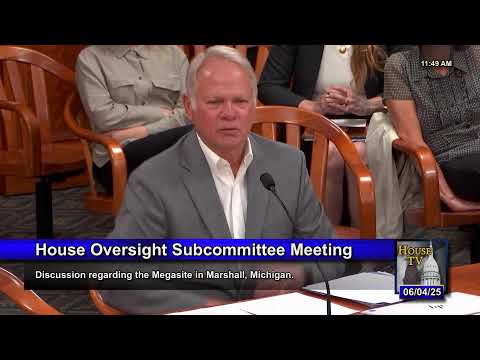
Julianne Bryant, a Marshall Township resident and community activist, and Glenn Kowalski, Marshall Township treasurer, told the Michigan House oversight subcommittee on corporate subsidies and state investments that secrecy and heavy state involvement accompanied planning for the proposed Marshall "mega site," an industrial complex tied to Ford and a Chinese battery supplier.
Julianne Bryant, a Marshall Township resident and community activist, and Glenn Kowalski, Marshall Township treasurer, told the Michigan House oversight subcommittee on corporate subsidies and state investments that secrecy and heavy state involvement accompanied planning for the proposed Marshall "mega site," an industrial complex tied to Ford and a Chinese battery supplier.
Bryant said residents learned after the fact that the planned factory would sit within a half-mile of some homes and less than 12 miles from nearby military installations, and that the project had been advanced under nondisclosure agreements. "This is not just my story," she told the committee. "It wasn't disclosed to us... that our new home would be less than a half a mile from a proposed EV battery plant connected to the CCP." (Transcript testimony.)
Kowalski summarized the community's account of a multi‑year, state-driven effort. He told the committee the Marshall Area Economic Development Alliance (MEDA) and the Michigan Economic Development Corporation (MEDC) obtained state grants and planned infrastructure work beginning in 2019, while a sequence of land‑use changes expanded the site footprint from what residents said had long been roughly 700 acres to plans that reached into thousands of acres. "In conclusion, let me be blunt. The state of Michigan used taxpayer money to destroy the very community it claims to protect," Kowalski said. (Transcript testimony.)
Why it matters
Witnesses framed the hearing as a test of how state economic-development tools are used in rural communities. Testimony cited millions in state tax incentives, local tax abatements, nondisclosure agreements signed by local elected officials, and a roughly $100,000 dark‑money campaign backing a petition committee that opposed resident petition drives.
Key facts and…
Already have an account? Log in
Subscribe to keep reading
Unlock the rest of this article — and every article on Citizen Portal.
- Unlimited articles
- AI-powered breakdowns of topics, speakers, decisions, and budgets
- Instant alerts when your location has a new meeting
- Follow topics and more locations
- 1,000 AI Insights / month, plus AI Chat