Get Full Government Meeting Transcripts, Videos, & Alerts Forever!
Get email alerts on the Marshall Megasite topic
No spam. Unsubscribe anytime.
Marshall residents tell state panel secrecy, NDAs and dark money accompanied planning for proposed Ford 'mega site'
Summary
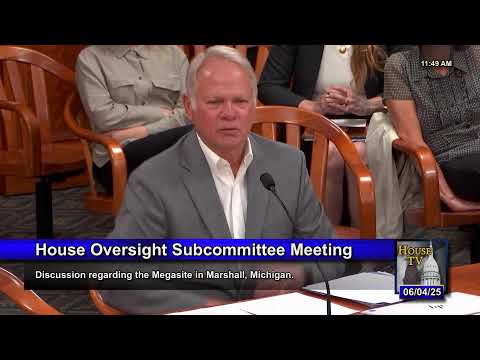
Julianne Bryant, a Marshall Township resident and community activist, and Glenn Kowalski, Marshall Township treasurer, told the Michigan House oversight subcommittee on corporate subsidies and state investments that secrecy and heavy state involvement accompanied planning for the proposed Marshall "mega site," an industrial complex tied to Ford and a Chinese battery supplier.
Julianne Bryant, a Marshall Township resident and community activist, and Glenn Kowalski, Marshall Township treasurer, told the Michigan House oversight subcommittee on corporate subsidies and state investments that secrecy and heavy state involvement accompanied planning for the proposed Marshall "mega site," an industrial complex tied to Ford and a Chinese battery supplier.
Bryant said residents learned after the fact that the planned factory would sit within a half-mile of some homes and less than 12 miles from nearby military installations, and that the project had been advanced under nondisclosure agreements. "This is not just my story," she told the committee. "It wasn't disclosed to us... that our new home would be less than a half a mile from a proposed EV battery plant connected to the CCP." (Transcript testimony.)
Kowalski summarized the community's account of a multi‑year, state-driven effort. He told the committee the Marshall Area Economic Development Alliance (MEDA) and the Michigan Economic Development Corporation (MEDC) obtained state grants and planned infrastructure work beginning in 2019, while a sequence of land‑use changes expanded the site footprint from what residents said had long been roughly 700 acres to plans that reached into thousands of acres. "In conclusion, let me be blunt. The state of Michigan used taxpayer money to destroy the very community it claims to protect," Kowalski said. (Transcript testimony.)
Why it matters
Witnesses framed the hearing as a test of how state economic-development tools are used in rural communities. Testimony cited millions in state tax incentives, local tax abatements, nondisclosure agreements signed by local elected officials, and a roughly $100,000 dark‑money campaign backing a petition committee that opposed resident petition drives.
Key facts and timeline
- Witnesses said MEDA applied for planning and site‑readiness grants in 2019 and worked with the MEDC on project planning. That work included studies of water and infrastructure capacity. - Residents and township officials said nondisclosure agreements (NDAs) were signed by some local officials, planning commissioners and others; those NDAs, witnesses said, limited public disclosure while state and private planning advanced. - A joint planning commission (JPC) vote on April 25, 2023, reportedly opposed rezoning the land for industrial use by a 4–2 margin. The Marshall City Council then voted on May 1, 2023, to approve the rezoning by a 6–0 vote, testimony said. Committee witnesses described a late appropriation attached to the council action; a township official recalled roughly $200,000 but said the appropriation’s stated purpose was not specified in the meeting record. - Citizens mounted petition drives for a referendum. Witnesses gave differing signature counts in testimony: at one point, they said they needed 600 signatures and obtained more than 800; at another point they said a citizen petition collected 810 signatures when 570 were required. The township’s petition committee challenged the city’s decision to reject the petition and the dispute is now before the Michigan Supreme Court, testimony said. - Residents described persistent local opposition: weekend protests at Brooks Memorial Fountain, robocalls and targeted mailers showing local residents’ faces with red Xs, and, witnesses said, a paid campaign by "Marshall Citizens for Jobs and Opportunities" financed by a $100,000 donation identified in local reporting. - Environmental and public‑health concerns cited by speakers included cleared farmland and woodlands, the loss of century‑old trees, documented soil‑erosion violations and fines by the Michigan Department of Environment, Great Lakes, and Energy (EGLE), and the site’s three miles of frontage along the Kalamazoo River. Witnesses said nearby neighborhoods rely on private wells and expressed concern about impacts to groundwater and air from industrial activity. - Witnesses said property removal and demolition have progressed; one witness estimated 20–30 houses removed and suggested about 1,200 to 1,300 acres already cleared toward a larger site footprint residents described as up to 3,000 acres. - Testimony also addressed national‑security concerns tied to a supplier identified in testimony as CATL. Witnesses said the Department of Defense has restricted Pentagon business with that supplier; they characterized the supplier as connected to the Chinese government and said the connection raised security concerns for the community.
What witnesses asked the subcommittee to do
Both speakers asked for greater transparency and questioned the use of state taxpayer funds for large corporate incentives. Kowalski and Bryant urged legislative scrutiny of MEDC’s process, the use of NDAs, and the role of third‑party groups that pushed local messaging. Kowalski also asked the committee to press local MEDA leadership, which he said had declined prior invitations to testify.
Quotes from the hearing
"It wasn't disclosed to us... that our new home would be less than a half a mile from a proposed EV battery plant connected to the CCP," Julianne Bryant said in her testimony.
"The state of Michigan used taxpayer money to destroy the very community it claims to protect," Glenn Kowalski told the committee.
Other details from testimony
- Witnesses described FOIA work that produced thousands of pages of documents; one speaker said Calhoun County released more than 6,000 pages after repeated requests. - Witnesses said a petition‑backing committee, represented by the law firm Clark Hill, mounted both legal and public relations efforts to oppose the citizen petition; an attorney associated with those efforts was later appointed to a state appeals court, testimony said. Witnesses named the attorney when criticizing the appointment. - On construction status and jobs, witnesses said the site is under construction and estimated the project to be roughly 60% complete; on‑site construction staffing was described in testimony as about 200 contractors, though other published materials cited higher hiring estimates.
Committee response and next steps
Committee members asked clarifying questions about NDAs, how petition circulation was limited, the water‑supply arrangements tied to Battle Creek, the role of local tax abatements and the appropriations attached to the council vote. The subcommittee record shows the panel received the testimony and did not take a formal vote on policy changes during the hearing. At the committee's opening, Representative Bierlein moved to approve the minutes of a prior meeting; the motion carried without objection.
Legal and procedural status
Witnesses said multiple legal challenges remain pending, with one citizen‑petition challenge at the Michigan Supreme Court. Several matters cited in testimony—rezoning votes, PA 425 land‑transfer agreements, local appropriations and tax‑abatement decisions—are matters of local government process and local ordinance. Witnesses asked the legislature to review how state economic development incentives and NDAs are used in similar projects.
Tapered ending
Speakers closed by repeating calls for transparency and for state officials to answer detailed questions; witnesses told the committee they will continue litigation and public protest while urging legislative scrutiny of state development practices.