Get Full Government Meeting Transcripts, Videos, & Alerts Forever!
Get email alerts on the Local Government Procedures topic
No spam. Unsubscribe anytime.
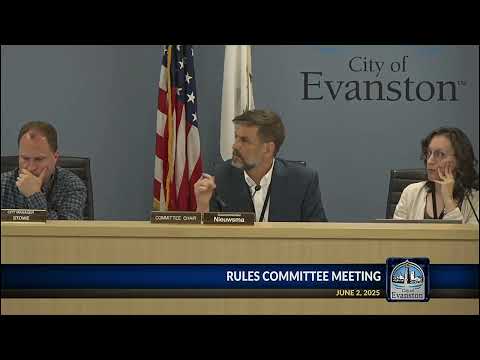
Evanston rules committee trims mayor's special-vote clause, adopts a slate of procedural changes
Summary
The Evanston Rules Committee on June 2 approved a series of procedural changes to the city's council rules, including deleting a provision that would have allowed the mayor to turn a 4'3 vote into passage and instead adopting language that aligns mayoral voting with state law.
The Evanston Rules Committee on June 2 approved a series of procedural changes to the city's council rules, including deleting a provision that would have allowed the mayor to turn a 4'3 vote into a passage and instead adopting language that aligns mayoral voting with state law. The committee also voted to require a two-thirds council vote to name an acting mayor, set a new timeline for conflict-of-interest consultations with the law department, restore a practice of reading consent-agenda item titles at council, and adopt target meeting end times.
The committee's actions matter because they change how narrow votes, recusals and day-to-day council staff interactions will be handled, and some approved changes will require matching amendments to the Evanston municipal code. The committee said staff will draft formal text reflecting the committee's direction for review at a later meeting.
The most contested item was a provision in the draft rules that would have allowed the mayor to cast a deciding vote on measures that received only four of seven councilmembers'support (a 4'3 result). Councilmember Kelly Rogers moved to delete that provision; the motion passed 5'4. After that vote the committee unanimously approved substitute language that mirrors the Illinois Municipal Code and the city code's existing conditions under which a mayor may vote. Corporation Counsel Alex Ruggie explained the legal baseline for remote participation and voting: "We still do follow the Open Meetings Act for remote participation." (Alex Ruggie, Corporation Counsel.)
Chair Nussbaum and council members who defended retaining state-law text said the change ensures alignment between the rules and Illinois law and avoids creating a new local voting power that would need to be enacted in the municipal code. Opponents said removing the 4'3 lever would reduce a procedural path for resolving votes when members are absent.
The committee also approved a requirement that the council must appoint an acting mayor by a two-thirds vote (6 of 9), a change that passed 5'4 and will require code changes to implement. Mayor Biss told the committee he supported maintaining the historic nonvoting, ex officio character of the mayor's membership on boards and commissions: "I support this role being a non voting role. I think that's the that's been the practice, I see no reason to change it." (Mayor Biss.)
On conflicts of interest, the Rules Committee adopted a new process requiring councilmembers or other parties raising a potential conflict to submit the issue to the law department by 10 a.m. on the day of the meeting so the city's lawyers can review and notify the affected members; that motion passed 8'1. The committee also struck a proposed section that would have allowed the council to make its own formal determination of conflicts (that section was deleted 9'0). The committee adopted a recusal practice that requires members who are recusing themselves to leave the room if there will be debate on an item.
Committee members also approved several other procedural changes: staff should preserve and maintain council members'access to records "as allowed by law" (vote 9'0); the consent agenda will include a reading of item titles when presented to full council after members pressed to restore that practice (vote 8'1 in favor of keeping the existing language); and the committee directed staff to draft consistent referrals language to clear up where the mayor's referral power appears in the rules. The committee also adopted guidance that written communications from councilmembers to departmental staff should include the relevant department director and the city manager (or deputy city manager) so work is visible and prioritized by management.
Public commenters had urged clearer limits on the use of "special order of business," a designation that sends items directly to the council rather than through advisory boards or commissions. Paul Breslin (First Ward) warned about a change tied to mayoral voting: "I don't like the rule change that says that a vote of 4 3 when 7 members are present can be changed to a defeat if the mayor jumps in and votes no." (Paul Breslin, First Ward.) Mary Rozinski told the committee she wanted a tighter definition of what constitutes an emergency worthy of a special-order designation: "The special order of business . . . needs to be a tool that's used for emergency purposes." (Mary Rozinski.) The committee added a staff directive to draft a definition of special order of business for later review.
Other votes: the committee authorized four ward mailings per councilmember per year (passed 5'4), and set target meeting times intended to shorten late-night sessions: open session should conclude by 10 p.m. and meetings generally by 11 p.m., unless a majority of the council votes to continue (adopted 7'2). The committee indicated many of the changes will require staff to prepare specific wording and, in some cases, municipal-code amendments before the committee acts on final text.
The Rules Committee held several procedural votes during the meeting unrelated to rules language: it approved moving the August council meeting from the third Monday to the fourth (9'0), allowed Councilmember Perry L. Davis to participate remotely under Open Meetings Act exceptions (unanimous), and tabled the item to fill a vacancy on the Social Services Committee until the next Rules Committee meeting.
The committee paused its review at the end of the evening and set a continuation for July 7; staff will return drafted ordinance/code language and a revised rules packet reflecting the committee's directions. The committee's changes are procedural, but several require coordinated municipal-code amendments before they take full effect.
Ending: The Rules Committee will reconvene July 7 to review staff'drafted text implementing the directions taken June 2; items that affect city code will be routed for the code-change process and additional review.