
Shelbyville Bedford Partnership requests $100,000 from county to expand tourism, workforce and economic development
Get AI-powered insights, summaries, and transcripts
Sign Up Free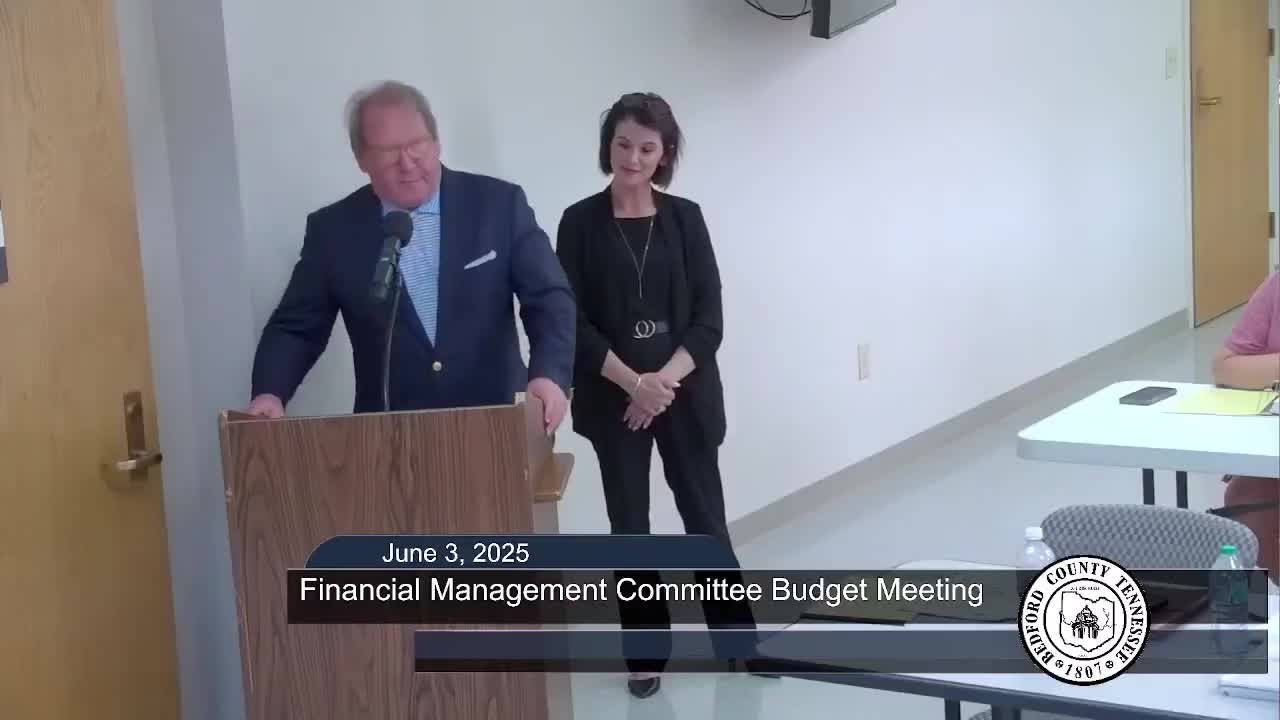
Summary
The Shelbyville Bedford Partnership presented a $100,000 funding request to the commission, outlined recent grant success and described a legal merger with the Chamber of Commerce; commissioners asked for more granular financial detail and ROI data.
Jody Lambert, chair of the Shelbyville Bedford Partnership, asked Bedford County commissioners during a work session to invest $100,000 in the nonprofit partnership to support tourism, workforce and economic development programs; commissioners did not vote on the request at the study session.
Lambert laid out the partnership's recent grant activity and economic arguments for public investment. He said the partnership secured about $138,400 in tourism-related grants and cited a Tennessee Department of Tourist Development study claiming that "for every $1 of expenditure on tourism advertising resulted in $11 of tax revenue," a figure he used to illustrate potential returns from modest county investment.
Why it matters: The partnership seeks public funding to expand programs that leaders say generate private-sector activity and sales tax revenue; commissioners pressed for more detailed, line-item financials and clarified how the partnership differs from the Chamber of Commerce.
Key points from the presentation and Q&A
Scope and organization: Lambert described the partnership as a coordinating entity for tourism, workforce development, economic development, the Chamber of Commerce and the Shelbyville Bedford Community Foundation. He said the partnership is organized as a 501(c)(6) and the foundation as a 501(c)(3) to allow different kinds of contributions and tax treatment.
Grants and claimed returns: Lambert said the partnership had secured roughly $138,400 in grants and used the tourism study to project downstream revenue; he presented a return-on-investment figure for the partnership—an aggregate R.O.I. number the presenter characterized as the product of multiple assumptions and an analysis performed by partnership staff.
Staffing and finance: Partnership staff told commissioners the operation currently employs two full-time staff members and one part-time staff member; salaries and operating revenues are generated through a mix of public and private contributions. The partnership reported it had submitted an annual report and financials to the county finance office at commissioners' request.
Merger with the Chamber: Kelly, a partnership staff member and former Chamber employee, explained that the Chamber's hotel-motel tax role shifted in 2019 and that the city and county later supported creating the partnership. When Chamber staffing fell, leaders said the organizations agreed on a legal merger that made the Chamber a functional arm of the partnership while preserving chamber services and member events.
Questions and requests from commissioners and public: Commissioners asked for a more granular ROI analysis and copies of the partnership's financials; Lambert and Kelly agreed to provide a detailed recap and to email financial statements and grant breakdowns to the commission. Commissioners also asked whether the partnership expected to be self-sufficient in five years; Lambert said the partnership considered itself "self sufficient" in the sense that grant- and event-driven revenue helps grow the local tax base and the partnership returned value by generating tax receipts for the jurisdiction.
No formal action: The county commission took no vote on the $100,000 request during the study session. Commissioners said staff and partnership representatives should return with detailed financials and program-level outcomes for further review before any funding decision.
Lambert highlighted tourism assets cited by the partnership for growth potential, including the Duck River, the Celebration RV venue and nearby whiskey-related tourism routes, and urged a coordinated effort to expand visitation and associated taxable activity.