Get Full Government Meeting Transcripts, Videos, & Alerts Forever!
Get email alerts on the Land Use Development topic
No spam. Unsubscribe anytime.
Council approves Arches Bayfront rezoning; comprehensive-plan amendment cleared unanimously
Summary
After hours of testimony and negotiated conditions, the Town Council approved a rezoning to a commercial planned development for the Arches Bayfront site (4-1) and separately approved the related small-scale comprehensive-plan map amendment unanimously.
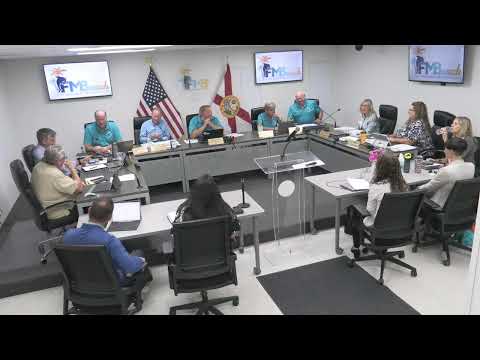
Fort Myers Beach's Town Council took up a months-long, heavily litigated set of land-use proposals on June 2 and approved the developer's rezoning request to a commercial planned development (CPD) and a related future land use map amendment.
The council voted 4-1 to approve the ordinance rezoning roughly 4.98 acres (the Arches Bayfront proposal) to a CPD that would allow a mixed-use development including lodging units, retail and waterfront open space, subject to a package of conditions and several deviations from the land-development code. Council members recorded a robust public record of neighborhood concerns about height, buffering, drainage and parking; staff and the applicant agreed and refined conditions during the hearing.
Separately the council voted unanimously to adopt the companion small-scale comprehensive-plan amendment to change about 3.53 acres of marina future land use and 1 acre of mixed residential to pedestrian commercial, the map change needed for the CPD to operate under local planning rules.
What changed: The applicant offered a list of conditions during the public hearing that staff incorporated and clarified; highlights included commitments on pedestrian access points, a plan for drain inlets aimed at relieving a longstanding ponding pocket on Third Street, a requirement for a concrete privacy wall between the development and adjacent backyards (to be rebuilt as development phases proceed), and a parking-study mechanism to validate any commercial paid-parking the developer may operate on site.
Noise, screening and gates: Council and staff pressed the applicant on the location and treatment of gates at the ends of Bonita Street and Harbor Court; the developer showed several options for gated solutions and the council requested a narrower turnaround and gate placement that minimizes public intrusion. Landscaping, wall finish and rooftop-screening provisions were added to address neighbor concerns.
Parking: Councilors and staff did not finalize an immediate approval for paid public parking at the CPD. Instead the council granted the development an early, conditional allowance for reduced parking subject to a post-occupancy parking study: if the study shows parking is short, additional mitigation (valet, operational changes or other steps) must follow; if the study validates more commercial spaces, the developer may seek a staff-level sign-off rather than a fresh rezoning.
Why it matters: The Arches proposal was among the most consequential development requests the town has considered since the storms: it would densify a prime downtown waterfront block and add lodging, retail and a ferry/water-taxi terminal. Council members balanced economic development and waterfront access against neighborhood impacts on traffic, noise and stormwater.
Quotable: Judith Frankel, the town's planning official, told the council the project as conditioned "is compatible with downtown uses but requires careful mitigation for abutting residences." The council ultimately weighed those conditions and, after amendments and discussions, approved the zoning and the map change.
Next steps: The developer must complete the conditions in the approved ordinance and obtain required permits, including federal and state approvals for work in coastal areas. The council's approvals put the project on the path to development under the negotiated conditions; staff will monitor compliance and carry the post-occupancy parking study requirement.
Ending: Council members said they would continue to watch project details closely during the permitting and construction phases; neighbors and the developer will return to the town for follow-up items as the project moves to design and build stages.