Get Full Government Meeting Transcripts, Videos, & Alerts Forever!
Get email alerts on the Homelessness Public Camping topic
No spam. Unsubscribe anytime.
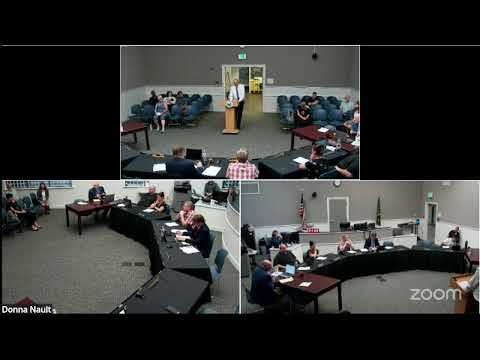
Shelton council adopts ordinance banning public camping; enforcement tied to policy development
Summary
After hours of public comment, the Shelton City Council on June 17 adopted Ordinance 2029-0525 amending Shelton Municipal Code 8.74 to prohibit sleeping or residing in temporary shelters on public property. The ordinance creates misdemeanor penalties but delays enforcement until the city manager finalizes policies and procedures.
The Shelton City Council voted to adopt Ordinance 2029-0525 on June 17, 2025, amending Shelton Municipal Code Chapter 8.74 to prohibit “to reside or sleep in a tent, hut, lean-to or other temporary shelter or structure” on public property and establishing misdemeanor penalties for violations.
The ordinance defines camping, sets a maximum penalty of up to 90 days in jail and a $1,000 fine, and says a misdemeanor will not be charged if law enforcement has offered resources and the person accepts the offer or agrees to relocate. City Manager Mark Ziegler told the council that “the policy shall include the procedures for the removal of personal property associated with camping, and this ordinance shall not be enforced until the policies have been developed and finalized.”
Why it matters: The ordinance touches daily life in downtown Shelton — including Brewer Park — and sets a new local criminal prohibition while tying enforcement to an implementing policy the city must still write. That combination prompted extensive public comment and debate over public safety, fiscal cost, and alternatives to criminalization.
Council action and next steps
The council took a formal vote on the ordinance after a lengthy public hearing. Recorded votes in the roll call included Council Member Julie Blush (aye), Council Member Jan Gilmore (no), Mayor Eric Nesco (no), Deputy Mayor Sherman (aye) and Council Member Sapp (aye). The motion carried and the ordinance was adopted as presented. Ziegler and city attorneys said the city will not begin enforcement until the manager’s policies and procedures are complete.
Public comment: concerns, data and alternatives
More than two dozen members of the public addressed the council. Judith Whitaker, a nearby resident, said, “I am not in favor of public camping. However, a more realistic approach of dealing with the problem is necessary,” and urged the city to identify a site that could be used as a managed temporary camping area with rules and services.
Danielle Bland, who identified herself as a Salvation Army service expansion coordinator, told the council that “criminalizing the homeless population currently residing within the Shelton City” will push people into worse situations and urged the council to consult established service providers before adopting policy.
Colleen Carmichael, executive director of New Horizon Humanities, cited research during public comment: “22 different cost studies show that chronically homeless people cost taxpayers an average of $35,000 a year,” and urged investment in permanent supportive housing and services as a more cost-effective alternative to incarceration.
Other commenters represented a range of views. Business owners and downtown residents described impacts they attributed to encampments and drug activity; outreach workers and case managers warned that citations, fines or jail time will not address underlying mental-health and addiction needs and may increase costs for the community.
Council discussion and legal context
City Manager Mark Ziegler said the draft ordinance follows current legal developments and local counsel’s review. He noted the city originally adopted shelter- and camping-related rules in 2021 and that recent federal jurisprudence has shifted: city staff referenced U.S. Supreme Court guidance since 2024 on whether local penalties for public camping are permissible when alternative shelter exists.
Ziegler also explained a substantive wording change in the ordinance: the definition of camping was changed from “remaining overnight” to “to reside or sleep,” to reduce ambiguity about when enforcement could apply. He said enforcement procedures and property-removal rules will be set by the city manager’s implementing policy.
What the ordinance does and does not do
- Establishes a misdemeanor for residing or sleeping in a temporary shelter on public property, punishable by up to 90 days in jail and up to a $1,000 fine. - States that criminal charges will not be pursued if an officer offers resources and the person accepts or agrees to relocate. - Directs the city manager to develop enforcement policies and property-removal procedures; the ordinance will not be enforced until those policies are finalized.
What proponents and opponents said
Supporters said the ordinance gives law enforcement clearer authority to address repeated public-safety problems downtown and to require behavioral accountability for people engaging in criminal conduct. Opponents said the ordinance penalizes people without housing, will be costly to implement, and risks criminal records that make housing and employment harder to obtain. Outreach providers repeated that citations and incarceration frequently fail to produce long-term stabilization.
Outlook
Council members asked for additional work on logistics, including where people would be relocated, storage for personal property, cost estimates for enforcement and potential litigation risk. Several council members and members of the public urged the city to pursue mitigation and shelter options in parallel with ordinance implementation. The council adopted the ordinance but placed enforcement on hold pending the city manager’s policies.