Get Full Government Meeting Transcripts, Videos, & Alerts Forever!
Get email alerts on the Housing Condo Conversions topic
No spam. Unsubscribe anytime.
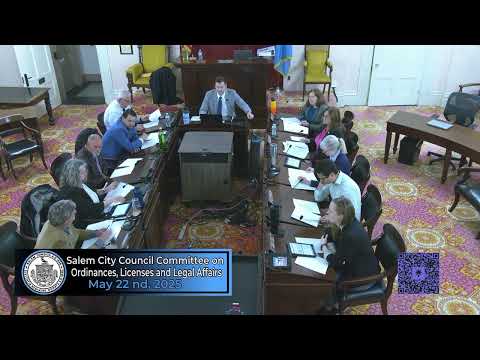
Salem committee approves amendments to condo-conversion rules, sets timetable for tenant relocation payments
Summary
The Salem Committee of the Whole on May 20 voted to amend a condominium-conversion ordinance, shortening a developer notice/look‑ahead period, correcting drafting errors and requiring relocation payments be split 50% before move-out and 50% after. The measure was sent to the full City Council with a positive recommendation.
The Salem City Committee of the Whole on May 20 approved amendments to a proposed ordinance regulating condominium conversions, reducing a developer “look-ahead” period from two years to one, correcting drafting errors and setting the timing of tenant relocation payments at 50% up front and 50% after vacancy. The committee voted to send the revised ordinance to the full City Council with a positive recommendation.
The changes approved at the Committee of the Whole meeting affect sections of the draft ordinance that were highlighted in the meeting packet. Councilors accepted an amendment that replaced a two-year “look forward” notice with a one-year look-ahead and made two editorial corrections in the relocation-payments section (inserting the word “older” before “adult tenants” in one clause and fixing a verb tense in another). The committee also approved a separate motion, moved by Councilor Cohen, requiring relocation benefits be paid 50% at least 15 days before a tenant’s move date and 50% within 10 days after the tenant vacates.
Lori Stewart, Housing Stability Coordinator for Salem City, described how the local ordinance treats relocation payments differently than state rules. “The relocation payments in our ordinance are per household,” Stewart said, adding that the state law she cited treats payments on a per-tenant basis. Planning Department staff member Amanda Chincula told the committee that single-family homes rarely — if ever — are converted to condominiums in Salem and that most conversions the city sees involve two or more units. “We were thinking about this, and we couldn't think of situations where a single unit, a single-family home would be converted into a condo,” Chincula said.
Councilors debating the amount and timing of payments cited competing concerns: several councilors and tenant advocates said the market cost of moving and securing replacement housing is high and that prompt partial payments would reduce displacement hardship, while some owner-occupant landlords and other speakers warned the provisions could impose costs that affect small, long-time local owners. Councilor Morisot (mover of the drafting corrections and the 1‑year look-ahead change) said the ordinance’s intent is tenant protection, not to stop conversions. “My intent with this ordinance was tenant protection, helping them find a new place and helping them afford a new place,” Morisot said.
Public comment included residents and property owners offering contrasting perspectives. Ed Cialdoni, a longtime Salem resident and landlord, told the committee that he opposed raising relocation payments above the state amounts and that landlords face substantial renovation and conversion costs. “It's absolutely crazy,” Cialdoni said, referring to proposals he viewed as excessive. Alex Rice, a local owner-occupant and contractor, said many small owner-operators renovate and improve units and that the proposed rules could have unintended effects on neighborhood investment.
The committee recorded two formal, successful outcomes: approval of the drafting corrections and the one-year look-ahead change (as amended in the packet), and approval of Councilor Cohen’s motion to pay relocation benefits in two installments (50% at least 15 days before move-out and 50% within 10 days after vacancy). The committee then voted to refer the amended ordinance to the full City Council with a positive recommendation. The full Council will consider the ordinance at a future meeting.
The ordinance as amended retains other substantive elements discussed earlier in the drafting process (including the relocation-payment amounts in the draft: $8,000 per unit for certain protected classes and $6,000 for other qualifying households, as reflected in the committee materials), and staff told the committee those dollar amounts and the ordinance’s applicability to buildings with two or more units reflect a local policy choice intended to align with state housing law and the Affordable Homes Act. City Solicitor Beth Renard and Planning Department staff remain the staff contacts for technical questions and for any further edits before the full Council takes up the measure.