Get email alerts on the Public Safety topic
No spam. Unsubscribe anytime.
Sheriff seeks county OK to pursue Flock Safety license-plate reader system for highways
Summary
Sheriff Eads asked the Dickson County Commission to move a proposed 12-site Flock Safety license-plate reader system to the regular meeting for approval; the quoted annual cost for 12 sites is about $36,000.
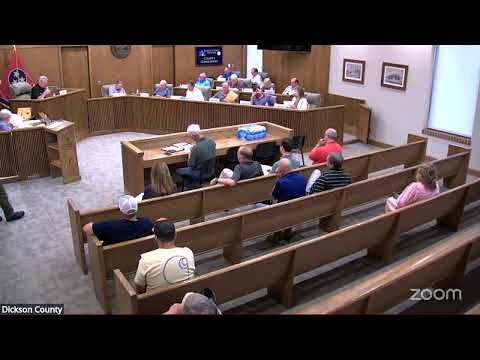
Sheriff Eads asked the Dickson County Commission on June 2 to place a proposed contract with Flock Safety on a future regular meeting agenda so the county can consider installing up to 12 license-plate reader (LPR) sites along major state highways.
“Sheriff Eads” described the technology as an investigative tool that “reads tags” and compares them with a hot list from the CBI to locate stolen vehicles, missing persons and other alerts. He said Flock’s package is “all inclusive,” runs on solar and cellular service, includes installation and replacements, and that his office has forwarded the contract to county attorneys for review. Eads estimated the annual cost for 12 locations at about $36,000.
Commissioners asked clarifying questions about capabilities and scope. Commissioner Buckner confirmed the $36,000 figure covers all 12 sites. Sheriff Eads emphasized the system is not a speed-enforcement camera and that the technology looks for plates on a law-enforcement hot list rather than issuing citations.
Commissioner Gray moved and Commissioner Ledger seconded a motion to place the contract before the regular session; the motion passed on a voice vote. The sheriff said he will arrange a product demonstration for commissioners who want more detail.
AI generated
The text on this page is AI generated. Summaries, highlights, analysis, and video transcripts are all produced from the original source material.
AI can make mistakes, so if you spot one, and we will fix it for everyone.
Note: the source content is unaltered by us. Any content source we link to, be it a video, an audio recording, or a document, is presented exactly as its publisher released it. That publisher is usually a government body, sometimes an individual official or another organisation.