Get Full Government Meeting Transcripts, Videos, & Alerts Forever!
Get email alerts on the Community Redevelopment topic
No spam. Unsubscribe anytime.
Lake City CRA consultant outlines boundary-expansion process, timetable and public outreach
Summary
A consultant hired to update Lake City’s Community Redevelopment Agency plan described a finding-of-necessity study and public-engagement schedule June 2, saying any boundary expansion would follow requirements in Chapter 163, Part III, Florida Statutes; no formal action was taken.
Lake City on June 2 heard an overview of a planned update to the Community Redevelopment Agency (CRA) plan and a proposed boundary expansion but did not take any action on expanding the CRA.
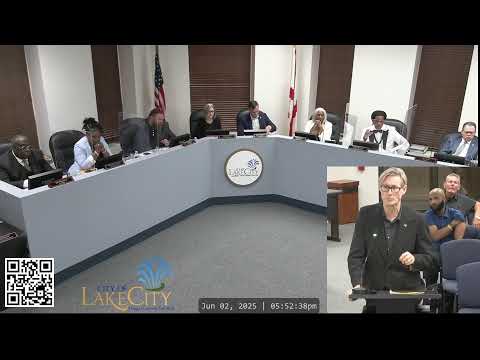
Eric Breadfelt, project manager for Inspire Placemaking Collective, told the CRA board the team is wrapping up kickoff and data collection and will move into a finding-of-necessity study required by state law. "We want something to be implemented. Otherwise, it's not good for the community," Breadfelt said, describing the firm’s emphasis on producing an achievable plan.
The consultant said the update will follow the requirements of Chapter 163, Part III, Florida Statutes, which governs CRA formation and activities in Florida. Breadfelt said the team has reviewed the CRA’s recent annual report and found the trust fund currently generates roughly "$300,000 to $400,000 annually," based on a 02/2023 report he located online.
Breadfelt outlined a multi-step schedule: kickoff and data collection in May–June; the finding-of-necessity study in June–July with a report expected in July–August; public engagement through August–September; and a draft plan aimed for the holidays with formal approvals following in the new year. Public engagement methods will include a project website with a map and survey, roughly "6 to 8" stakeholder interviews, and evening community workshops, he said.
On the proposed expansion map shown to the board, the consultant identified three zones: the original CRA area, a 2011 expansion and a darker-shaded area staff proposed for additional expansion. Breadfelt said the team will assess statutory checklist criteria for expansion and perform comparative analysis against other parts of the city (for example, property-value trends and code-enforcement indicators) before recommending any boundary change.
When board member Mister Jernigan asked whether tax-increment revenues raised on one side of town could be spent elsewhere inside the CRA, Breadfelt said programming generally allows spending within the entirety of the CRA area and noted the board should weigh implementation capacity before enlarging the boundary.
The presentation included background on CRA funding and allowable uses: the redevelopment trust fund captures incremental property-value growth and can be programmed for personnel, programs such as façade grants or capital projects such as streetscaping and sidewalks. Breadfelt cautioned the board to consider capacity and long-term constraints if it enlarges the taxing area.
No formal motion to expand the CRA boundary or to adopt plan language was made at the meeting. The board approved the meeting agenda and the April 7, 2025 minutes by voice votes. Breadfelt and staff will return with the finding-of-necessity report and draft plan materials for the board’s review and potential resolution at a future meeting.
The meeting began with a roll call and a reading of public-meeting decorum; public participation had no signed speakers. The presentation occupied the substantive portion of the agenda.