Get Full Government Meeting Transcripts, Videos, & Alerts Forever!
Get email alerts on the Transportation Impact Fees topic
No spam. Unsubscribe anytime.
Palm Coast council delays decision on updated transportation impact fees after wide-ranging debate
Summary
City council on June 3 reviewed a proposed update to Chapter 29 (transportation impact fees) that would raise many fees based on a 2050 roadway plan and rising construction costs; council directed staff to rework costing assumptions and tabled the ordinance to the next workshop for more detailed numbers.
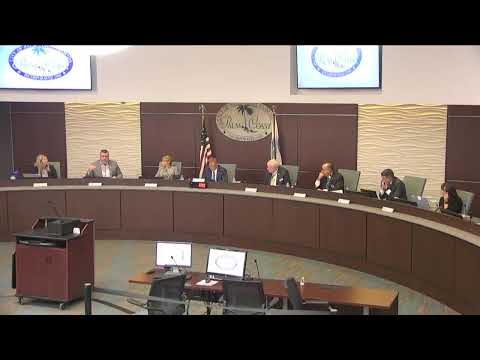
Palm Coast City Council on Tuesday began — but did not finish — a contentious review of proposed transportation impact fee increases that would fund road projects through 2050, then tabled the ordinance after lengthy council and public discussion.
The first reading of an ordinance to update Chapter 29 (transportation impact fees) would have raised rates for several land-use categories, reflecting a recalculated capital plan and higher construction costs. City consultant Jonathan Paul of New Urban Concepts told the council the updated plan initially calculated roughly $157 million in roadway improvements, later revised to about $124 million after the council asked staff to remove a portion of U.S. 1 and to assume additional outside funding. Paul said the per-mile construction cost used in the update rose from roughly $7 million in 2018 to about $15 million in the current study.
Why it matters: The update would shift more of the cost of future road capacity to new development and affect the price of single-family and multifamily home permits and commercial building permits. Several council members and residents pressed staff on assumptions — especially whether to include future inflation in project costs and how much outside funding (state, TPO) is realistically available for State Road 100 improvements.
Key facts and staff direction: The consultant described several design choices the council had already directed: removing improvements on U.S. 1 from the feeable project list, exploring a tiered residential approach keyed to house size, and adding grant funding assumptions for State Road 100. Staff reported those changes reduced many proposed fee increases; for example, after removing U.S. 1 and adding $25 million in assumed external funding earlier in the process, the estimated single-family fee for homes larger than 2,000 square feet fell to about $6,000 per dwelling (staff noted slightly different numbers as the analysis evolved). Staff also proposed an effective-date plan tied to state notice requirements: a 90-day delay after adoption before new fees apply.
Concerns raised: Several council members, applicants and residents urged caution. Vice Mayor Pontieri and others asked staff to model project costs in future dollars (to reflect likely inflation between now and construction), to reduce the assumed external funding to a conservative amount tied to current FDOT work-program commitments, and to consider a per-square-foot residential methodology rather than an arbitrary size threshold to protect affordability. Builders and home‑building trade representatives urged clarity and urged the council not to adopt fees that could impair construction without clear notice.
Outcome and next steps: After extended discussion and public comment, council voted unanimously to table the first reading and asked staff and the consultant to return with revised calculations at the next workshop (staff committed to providing updated numbers before the workshop). Council members repeatedly said they preferred seeing the new detailed fee spreadsheets and funding assumptions in writing before a second reading.
Meeting context: The debate lasted several hours, included staff presentations, consultant explanations and many public speakers representing builders, homeowners and civic groups. Council emphasized legal defensibility (statutory “extraordinary circumstances” rules were discussed) and asked that staff prepare the revised technical report to support any final decision.