Get Full Government Meeting Transcripts, Videos, & Alerts Forever!
Get email alerts on the Roso Overlay And Subdivision Amendments topic
No spam. Unsubscribe anytime.
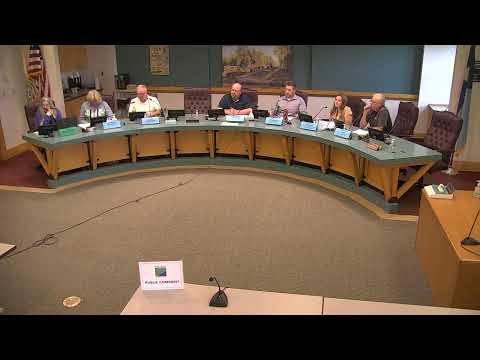
Planning commission recommends rezoning and subdivision changes to create residential open-space overlay
Summary
The commission voted to forward proposed amendments to create a Residential Open Space Overlay (ROSO) district and related subdivision-ordinance changes, including wildfire resilience review, septic-submittal clarifications, developer's-agreement language and a two-times density bonus tied to preservation of at least 50% open space.
The Cook County Planning Commission on May 14 voted to forward proposed amendments creating a Residential Open Space Overlay ("ROSO" or "Roseau District") and updates to the Cook County Subdivision Ordinance to allow clustered residential development at higher densities in exchange for preserving at least 50% of a site as open space.
Neva, Cook County planning staff, told the commission the overlay is voluntary and must be requested by property owners; it would apply only in non-shoreland areas of FAR 2 and FAR 3 zone districts and only where parcels meet eligibility criteria such as proximity (within one-half mile) to State Highway 61 or a county or township road. Neva said the overlay's purpose is to "allow residential uses at a higher density when there is corresponding preservation of open space." She noted the overlay requires a rezone public hearing and a separate public hearing for any subsequent preliminary plat.
The ROSO provisions would allow a density bonus up to double the maximum density of the underlying zone (FAR 2 or FAR 3) provided 50% of the parcel is intentionally preserved as open space and deed restrictions prohibit rentals shorter than 30 days. Design standards set minimum lot size (0.25 acre) and maximum lot size (2 acres) with setbacks and a per-lot impervious-surface limit (staff proposed clarifying language to reference impervious rather than overall lot coverage). Duplexes would be allowed as a conditional use provided each unit is on a separate platted lot.
Neva said staff had prepared three addenda to the proposed ordinance language clarifying definitions (including how non-pressurized dwellings such as yurts would be treated), septic submittal requirements for preliminary-plat review and proposed developer's-agreement detail. On septic review, the revision requires soil observation logs at preliminary plat stage showing suitable locations for septic systems (two observations per lot or a cluster-system site), with full septic-design submittal required at final plat.
Mike Kiebort, Cook County Emergency Manager and Firewise program lead, told commissioners that wildfire mitigation work and fuels reduction are part of county Firewise activities and that integrating wildfire-resilience review into the preliminary-plat stage is consistent with the county's wildfire-risk planning. "Any wildfire mitigation we can do ahead of the game is just putting us ahead of the game," Kiebort said, describing fuels reduction (chipping, hauling or controlled burning) and noting the Firewise program is grant funded.
County Attorney Jean Peterson told the commission she supports clearer developer-agreement language. Peterson said the proposed developer-agreement detail and county-specific financial guarantees "give more assurance that the project will be seen through to completion rather than just that the loan will be repaid."
Public commenters included local real-estate agent John Albertholzer, who said the proposal could help move underused lots and make housing more feasible, and Schroeder Township resident Kathy Johnson, who said she supports the changes and welcomed the prohibition on short-term rental in the overlay.
Commissioners discussed road-access and serviceability (maintenance and snowplowing), wildfire-resilience requirements, whether open-space areas could be publicly accessible, and the balance between development potential and infrastructure limits. One commissioner raised concern that language allowing open space "for use by the general public" could be interpreted as a public park dedication; staff and the county attorney clarified the provision is optional (the ordinance language uses "may") and that what is allowed in open space would be considered on a case-by-case basis during review.
After amendments discussed at the meeting (three staff addenda, clarifying impervious-surface language and updated septic wording from Environmental Health), a commissioner moved and the commission seconded to forward the zoning and subdivision amendments to the Cook County Board of Commissioners for their May 27 meeting with the addenda and the impervious-surface clarification included. The motion carried on a voice vote with no recorded opposition; the county board will hold the rezone hearing and additional public comment opportunities at its public meeting.
If approved by the county board, properties would need to be rezoned into the ROSO overlay and then proceed through the standard preliminary- and final-plat review before any density bonus or lot creation takes effect. Staff noted the overlay is voluntary and eligibility is limited by the ordinance criteria; site-specific features such as wetlands, septic suitability and road maintenance remain central to final project design and feasibility.