
Isle of Wight supervisors review growth scenarios as five‑year comprehensive plan update continues
Get AI-powered insights, summaries, and transcripts
Subscribe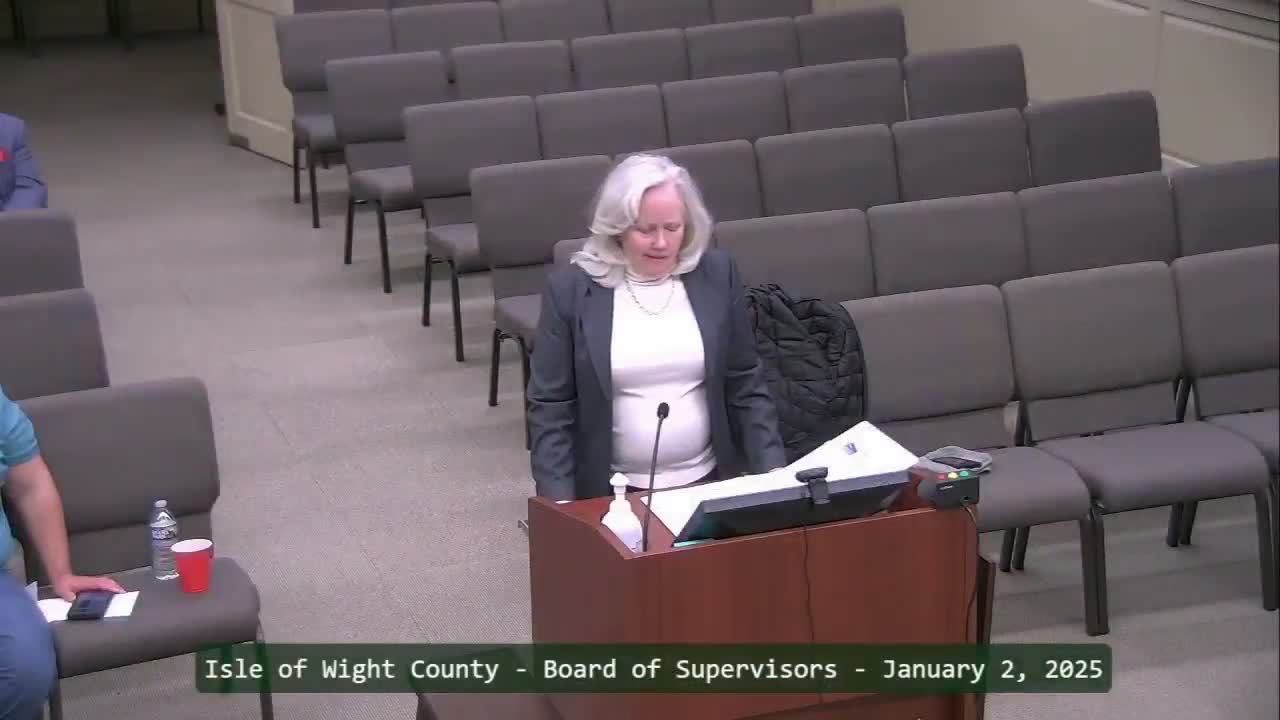
Summary
County staff briefed the Board of Supervisors on the five‑year review of the comprehensive plan, presented two preferred growth scenarios and a separate growth‑rate study. Consultants are expected to deliver preliminary growth‑rate findings in the coming weeks.
The Isle of Wight County Board of Supervisors on the organizational meeting agenda received an update on the county's comprehensive plan five‑year review and the growth scenario analysis from Amy Ring, the county's community development director.
Ring said the review follows state law and a multi‑phase public process that produced eight candidate growth scenarios and two preferred scenarios. "The code of Virginia requires that every locality review its comprehensive plan at least once every 5 years," Ring told the board, noting the county began the current review in summer and has run multiple public meetings and surveys.
The nut graf: the growth scenarios and an ongoing consultant study will guide where and how much the county plans for housing, commercial development and public facilities through 2040. The board and county staff said the analysis will inform budget planning and public‑safety, school and infrastructure needs tied to different growth rates.
Ring summarized the public engagement and analysis to date. The county's previous comprehensive plan process included more than 10 public meetings and a survey with more than 740 responses; for the current five‑year review staff ran additional meetings and surveys. In describing outreach for the current update Ring said one phase drew "409 survey responses" and later staff had a separate survey that she said received "the exact number, I think it was over 700" responses; staff said they are analyzing those results and assembling a redline draft of proposed plan changes for stakeholder review.
Ring said the county hired the consultant firm Tishler Vi(ce) in July 2024 to prepare a growth‑rate scenario study examining three trajectories: a historical (higher) rate, a moderate 1% rate and a more rapid 3% scenario. She said preliminary findings from the consultant were expected in the "next couple of weeks" and a fuller report by March. The firm also performed fiscal and market feasibility studies that, Ring said, found both preferred land‑use scenarios to be fiscally positive overall while flagging that some economic development assumptions were optimistic.
Ring provided planning numbers used in the analysis: the consultant's fiscal work projected an average annual population and employment growth rate of about 0.83% between 2020 and 2040; the county used an average household size of 2.4 to estimate housing needs and calculated roughly 2,731 additional residential units would be needed to accommodate that projected growth. Ring said the county's April 2020 housing inventory was 16,441 residential units and as of July 2023 there were approximately 17,566 units (about 1,100 added during that period); she noted staff did not have demolition counts on hand and would provide them later.
Board members pressed for more granular outputs and follow up analysis. Several supervisors asked the consultant to provide growth and development figures by magisterial district (rather than the county's service districts) or to break out residential versus commercial development geographically. Ring and other staff replied the study scope specified county‑wide growth scenarios plus analyses tied to Development Service Districts (DSDs), and that magisterial‑level reporting is possible though it can be complicated where districts overlap.
Supervisors also raised operational and fiscal implications: one supervisor asked staff and the consultant to estimate the additional recurring cost if volunteer fire and EMS services were replaced by fully paid personnel, saying the county should have a background estimate of that potential liability running alongside growth scenarios. Ring said the growth‑rate study will evaluate public‑facility needs and operational impacts tied to each growth trajectory. Don Keaton, the county administrator, confirmed the county will try to incorporate preliminary consultant numbers into upcoming budget discussions.
Ring said staff are assembling a master redline draft and expect to distribute it to the larger stakeholder group by the end of February and to have consultant deliverables available in March, which staff said would allow board members to use scenario results in the FY26 budget cycle.
Ending: The board did not take formal action on the plan at the meeting; supervisors asked staff to return with the consultant's preliminary growth‑rate results and to provide magisterial‑level breakdowns where feasible. Staff scheduled the next stakeholder working group meeting for the second Tuesday in February.