Get Full Government Meeting Transcripts, Videos, & Alerts Forever!
Get email alerts on the Public Health Budget topic
No spam. Unsubscribe anytime.
Spokane Regional Health District budget draws scrutiny as county reviews post‑COVID spending
Summary
County commissioners and health‑district leaders reviewed a decade of spending and staff growth at the Spokane Regional Health District; commissioners asked for options for scaled reductions and for detail on which programs rely on discretionary local dollars.
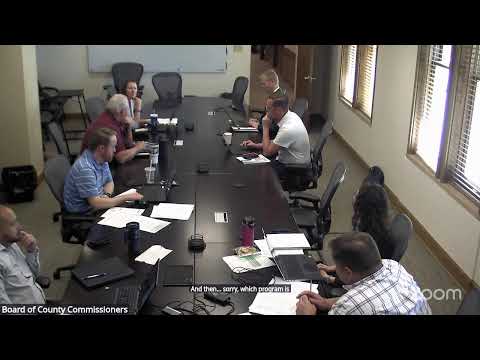
Spokane Regional Health District (SRHD) leadership met with county commissioners on June 2 to review the health district’s budget and explain how post‑COVID grants and new programs have changed local funding demands.
The presentation: SRHD leaders outlined the agency’s mission, strategic goals and the two primary local revenue streams that support discretionary local services: the county assessment and a state appropriation often referred to in the meeting as the motor vehicle excise tax replacement appropriation (the ‘‘2877318’’ replacement allocation). The health district’s total budget rose from about $36 million in 2019 to about $57 million in 2025, a change SRHD leaders attributed largely to pandemic funding and program expansion.
Key items discussed: Commissioners and SRHD staff focused on two major line items that have grown since the pre‑COVID baseline: communications/media (the health district reported media/communications spending rising to roughly $1.2 million, with about $200,000 supported by FPHS) and a health equity program (about $399,000 in local dollars with additional grant support). SRHD leaders said some communications spending shifted from ad hoc IT support to a permanent communications team that handles public information, media production and outreach. SRHD said some more recently added positions had foundation/public health service (FPHS) funding or federal grant support, but presenters acknowledged that portions of program staffing are funded with locally flexible dollars.
FPHS and other state funding: SRHD staff flagged reductions being considered at the State Department of Health that could reduce “foundational public health services” statewide. Staff said the state has identified cuts to FPHS and is asking local jurisdictions to participate in how an additional roughly $4 million statewide reduction would be allocated among local health jurisdictions. SRHD staff emphasized they were advocating to preserve the reinforcing‑capacity dollars that provide flexibility to respond to local needs; they also said the larger state and federal funding environment is in flux and could affect local programing.
County concerns and next steps: Commissioners discussed the degree to which SRHD’s post‑COVID operating baseline is sustainable and asked SRHD to return with specifics about what a surface reduction of $500,000–$1,000,000 would mean to services and staffing. Commissioners also asked SRHD and county budget staff to identify what county‑provided supports (for example, facility space, utilities and indirect costs) represent in dollar value, and to quantify which programs are funded by state/federal grants vs. flexible local dollars.
Ending: SRHD staff will return with a more detailed, line‑level analysis showing which reductions would be required at various dollar thresholds and with documentation of county in‑kind support and capital needs. Commissioners asked SRHD to treat this as a budget prioritization exercise for the coming budget cycle while noting the county’s overall fiscal constraints.