Get Full Government Meeting Transcripts, Videos, & Alerts Forever!
Get email alerts on the Behavioral Health topic
No spam. Unsubscribe anytime.
County and city revise co‑response pilot: fewer crisis providers on longer shifts, six‑month evaluation planned
Summary
Spokane County staff provided an update to commissioners on the county–Spokane City co‑response pilot, describing a programmatic shift from four simultaneous teams to staggered coverage with longer shifts and a six‑month evaluation phase while keeping the interlocal agreement terms intact.
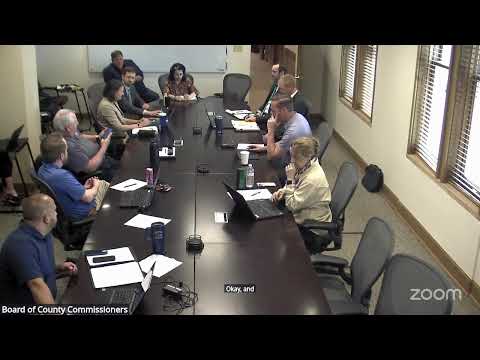
Spokane County staff updated the Board of County Commissioners on June 3 about changes to the planned county–Spokane City co‑response pilot pairing crisis behavioral‑health providers with paramedics. Justin (county behavioral‑health lead) said the operational plan now calls for staggered teams covering longer shifts rather than four teams operating simultaneously, while preserving the interlocal agreement (ILA) terms and a program cap.
County presenters said the original plan envisioned four teams (paramedic + behavioral provider) working simultaneously. City Fire advised that a single team can cover key hours with staggered staffing that increases shift length (12 hours) and may be easier to staff initially; Spokane City Fire will provide paramedics and vehicles, and county crisis providers will be assigned to the program at proportional paid time. The county and city plan a six‑month operating pilot and reassessment to determine whether expansion toward more simultaneous teams or 24‑hour coverage is warranted.
Justin said the county will not change the legal ILA terms negotiated with city legal counsel; programmatic staffing and scheduling will adjust to match practical coverage needs and available crisis‑responder hours. The presenters said crisis providers hired for the pilot will be new positions and that the county expected to scale the number of crisis clinicians assigned as hours demand—potentially three county crisis providers initially rather than four.
Commissioners asked about stationing and geographic coverage, and county staff said station location decisions remain under discussion with Spokane City Fire and will follow call‑volume analysis. Presenters said teams would be expected to respond across the city fire jurisdiction rather than limit operations to a single neighborhood; if only a single team is on duty it should be centrally staged to maximize response reach. The county confirmed that the city may base vehicles at city fire stations.
Staff said program billing and cost allocation will reflect proportional time that county crisis providers are engaged; time spent on other county work when assigned to the co‑response program will be excluded from program billing.
The county also provided a broader behavioral‑health funding update: presenters said the state healthcare authority had loosened some proviso restrictions, which county staff said freed funds for more flexible local use and reduced anticipated program cuts.
Ending — The county will bring the ILA back to the board for formal consideration (tentatively scheduled for June 17, with the possibility of the June 10 meeting if the board wishes to accelerate). Staff said they will run the pilot for six months and return with evaluation data and recommendations for expansion or adjustment.