Get Full Government Meeting Transcripts, Videos, & Alerts Forever!
Get email alerts on the School Policies topic
No spam. Unsubscribe anytime.
Council Rock policy committee advances student-policy package to second read, opens new confidentiality review
Summary
The Council Rock School District Policy Committee on June 2 reviewed a package of student-related policies and directed most to a second reading, while placing a new policy on confidential student communications on first reading.
The Council Rock School District Policy Committee on June 2 reviewed a package of student-related policies and directed most to a second reading, while placing a new policy on confidential student communications on first reading.
Committee Chair Tracy Osecki opened the meeting and turned the item-level discussion over to staff presenter Ron Spring, who walked the committee through a series of second‑read policies and one new first read.
The committee reviewed a delegation/authority policy where staff recommended using the conjunction “and” (rather than “and/or”) to align the district with PSBA guidance and neighboring districts; Spring said the district solicitor raised no objection to that choice. The committee recorded that change for the second reading.
Student discipline returned for second reading with no substantive changes from prior meetings; staff said the revisions chiefly clarify how the policy applies to on‑ and off‑campus activities. The weapons policy likewise stays as revised at the prior meeting, retaining the words “pistol” and “device” in the weapons definition, a wording the committee affirmed for second reading.
The terroristic‑threats policy was updated to replace the phrase “board member” under the authority section with the clearer term “school board director,” and staff noted that several district policies now more explicitly reference the district’s behavioral threat assessment teams because those teams were created after the original policies were adopted.
On student complaints, Spring said the revised policy broadens students’ access to complaint processes by removing highly prescriptive, one‑size‑fits‑all steps. As Spring read from the draft, “the board and its employees shall recognize the complaints of students provided that such complaints are submitted according to the established administrative regulations.” The committee discussed that the new language allows different complaint paths depending on the nature of the concern (for example, academic grade disputes, harassment claims, or counseling requests).
The student dress and grooming policy includes one substantive addition: an accommodation for students experiencing educational instability so that administrators may refrain from discipline when instability contributes to dress‑code noncompliance. Staff described that change as consistent with recent policy updates in other districts.
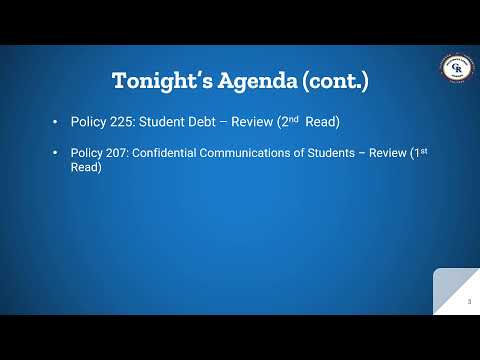
Staff said the student debt policy — covering overdue books and damaged property, distinct from school lunch account processes — was recently adopted in November 2023 and has no further changes now.
The policy placed on first reading addresses confidential student communications and closely follows statutory language. Staff cited “22 PA Code 12 12” and “42 PA CSA 59 45” in explaining when confidentiality applies and who controls privilege in legal proceedings; the draft also clarifies that staff acting in good faith who report suspected drug or alcohol abuse are protected from liability.
A committee member asked about mandated reporter responsibilities; a presenter reminded the committee that staff are required reporters and that the HR team tracks Act 126 compliance for district employees.
Committee members had no additional objections to the package as discussed; staff noted there will be no policy committee meeting in July and that the committee is scheduled to reconvene in August.
The committee’s discussion consisted of clarifications and technical amendments rather than final adoptions; the policies will return to the board for the next formal readings and any votes required by board rules.