Get Full Government Meeting Transcripts, Videos, & Alerts Forever!
Get email alerts on the Energy Efficiency topic
No spam. Unsubscribe anytime.
Yorktown board hears pros, cons of energy performance contracts; orders district-wide energy audit
Summary
Construction manager Paul Tasi briefed the Yorktown Central School District Board on energy performance contracts, solar options and tradeoffs; the board directed staff to begin a comprehensive energy audit and asked for analysis of putting solar on French Hill when its roof is replaced.
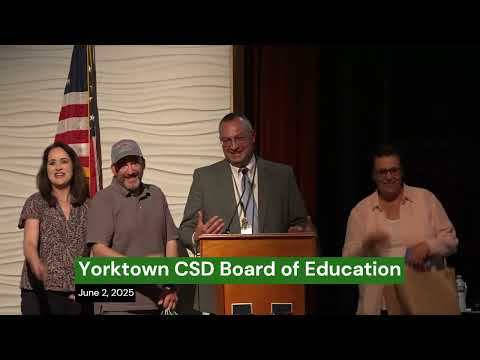
At the June 2 Yorktown Central School District Board of Education meeting, Paul Tasi of ARIS Construction briefed trustees on energy performance contracts, renewable options and tradeoffs, and recommended the district commission a comprehensive energy audit as the next step.
An energy performance contract, Tasi told the board, is “an agreement between the school district and an energy service company or ESCO for the provision of energy services in which energy systems are installed, maintain and manage to improve the energy efficient of or produce energy for a facility in exchange for a portion of the energy savings or revenues.” The board and staff discussed how that model compares with doing phased upgrades in-house or presenting a public referendum.
Why it matters: district leaders said improved energy systems could lower operating costs, improve classroom ventilation and lighting, and advance sustainability goals while minimizing immediate taxpayer burden. Tasi said energy performance contracts (EPCs) do not require voter approval and can qualify a district for an additional 10% building aid if included in a referendum, but they carry tradeoffs that affect price, control and long-term planning.
Tasi outlined common energy conservation measures (ECMs) in EPC proposals: LED lighting upgrades and automatic controls; HVAC replacement and controls; building-envelope work to reduce infiltration; replacement of domestic hot water systems; and renewable installations such as roof-mounted, canopy or ground-mounted solar photovoltaic arrays. He described the typical EPC procurement flow: a district or ESCO-funded comprehensive energy audit; an ESCO bid or RFP; a measurement-and-verification plan; and an EPC with a maximum 18-year term.
Tasi warned trustees about common pitfalls. EPCs “generally have a higher cost of energy conservation methods installed” because ESCOs typically include a sizable markup, he said. He also described contract complexity and performance-risk issues: measurement-and-verification claims can be difficult to reconcile over time and, in his experience, “I’ve never once seen a district be able to collect on [shortfalls]” despite guaranteed-savings language. He added that many ESCOs prefer lighting retrofits (replacing lamps and ballasts with plug-in LED replacements) that are sometimes ineligible for State Education Department building aid because they are not considered full fixture replacements.
Trustees focused on payback and timing. Board member Mike asked about the practical cash flow: “What you’re actually doing with the solar panels for the first 15 years is the, savings that you’re generating is going to pay for the panels.” Tasi confirmed that solar projects are generally financed so that produced or conserved energy covers installation costs over the contractor’s expected payback period — commonly modeled at roughly 15 years for school projects — and that panels degrade over time. Trustees also asked whether prior district upgrades would reduce project scope; Tasi said lighting is the low-hanging fruit for payback and that prior LED upgrades could reduce available savings but would still allow targeted projects elsewhere.
On renewables and roofs, Tasi emphasized the need to align roof useful life with PV lifetime. He singled out French Hill as an example: “One of the buildings that you really do need a roof on would be French Hill. So that would ... be one of the first buildings that I would look at,” he said, adding that roof structural analysis and coordination with roofing warranties are necessary before committing to roof-mounted solar. Tasi also said canopy and ground-mounted systems require additional geotechnical and structural work and are typically more expensive than roof-mounted systems.
Board decision and next steps: after discussion, trustees directed staff to commission a comprehensive district energy audit to identify ECMs, estimate savings and support a procurement decision. The board also asked that staff and ARIS analyze the cost of including solar on the forthcoming French Hill roof replacement so the district can consider that option alongside roofing planning.
The board did not approve an EPC or enter any binding contract at the June 2 meeting; members discussed options, tradeoffs and funding approaches and asked staff for follow-up information and cost estimates.