Get Full Government Meeting Transcripts, Videos, & Alerts Forever!
Get email alerts on the Higher Education Capital Investment topic
No spam. Unsubscribe anytime.
Committee hears $2.5 billion BRIGHT Act proposal to modernize, decarbonize public higher education
Summary
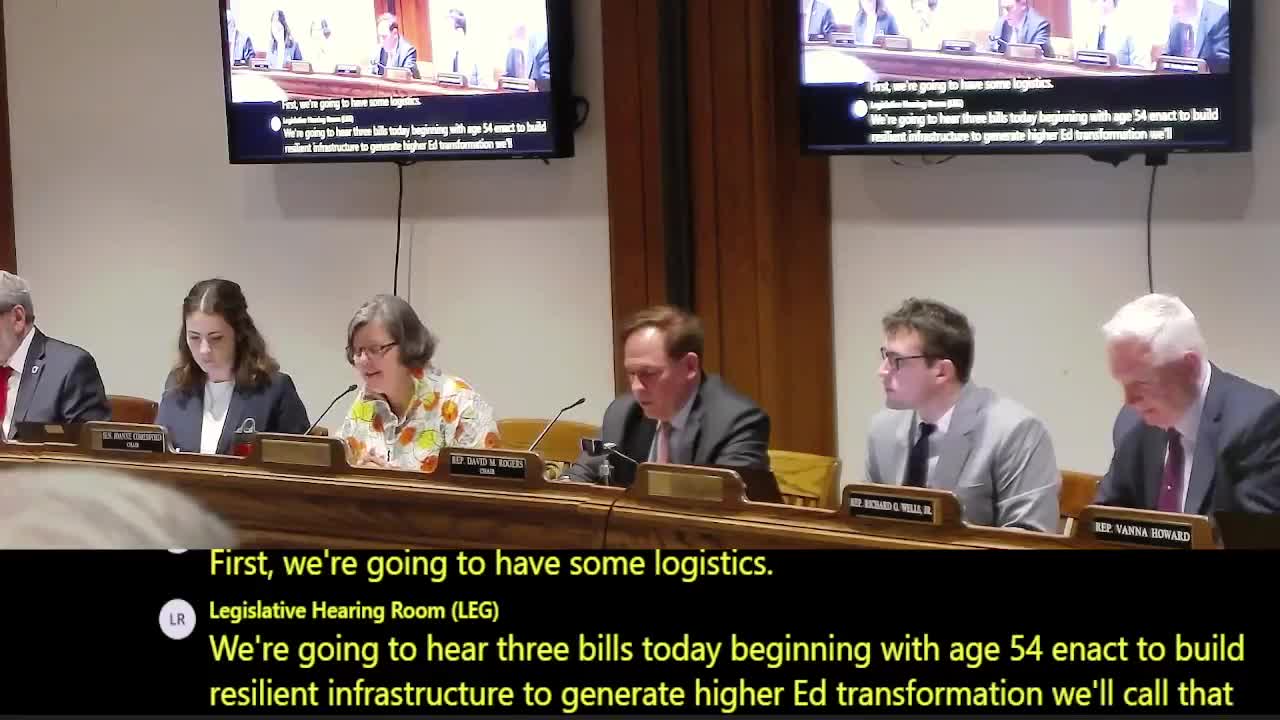
The Joint Committee on Higher Education held a public hearing on H.54, the BRIGHT Act, a $2.5 billion proposal to modernize and decarbonize state higher education campuses, with testimony from Governor Maura Healey’s administration, University of Massachusetts leaders, state university presidents, community college officials and construction and labor representatives.
The Joint Committee on Higher Education held a public hearing on H.54, the BRIGHT Act, a $2.5 billion plan to modernize public higher education campuses across Massachusetts and accelerate decarbonization, administration and university officials said.
University of Massachusetts President Marty Meehan told the committee the legislation represents “a generational investment” and urged lawmakers to act so campuses can repair aging buildings, reduce emissions and support research and workforce training. Governor Maura Healey’s office filed the bill; witnesses included members of the UMass system, state university presidents, community college leaders, DCAM and trade and construction representatives.
Why it matters: The commonwealth’s public campuses were built largely in the 1950–1970 period and now face a mix of deferred maintenance, outdated labs and high-energy systems. Administration officials said the BRIGHT Act would use fair-share surtax revenues to back special obligation borrowing and provide authorizations and targeted grants to get projects started quickly. The administration estimates the fund could support $2.5 billion in borrowing while creating thousands of construction jobs statewide.
Key numbers and structure - Proposed authorization: $2.5 billion for UMass, state universities and community colleges, plus $500 million in smaller targeted authorizations for master planning, small modernization projects, workforce skills capital grants, and land acquisition/disposition for housing. - Startup funding discussed: $175 million in one-time capital in the Senate fair-share supplemental (testimony), and a $125 million annual fair-share appropriation concept described in administration briefings to underwrite future special obligation bonds.
What witnesses said - President Marty Meehan (University of Massachusetts): said UMass faces large capital needs and framed BRIGHT as essential to align research, decarbonization and student success. He told the committee the university system faces “a significant burden of $4,800,000,000 in deferred maintenance need.” - Chancellor Javier Reyes (UMass Amherst): described Amherst’s campus needs — “our campus has a deferred maintenance need of $1,800,000,000” — and stressed the scale of built space and research labs on which the state depends. - Governor Maura Healey (testimony): described the proposal as a $2,500,000,000 investment in campuses and said the construction work would generate thousands of jobs and strengthen the state’s workforce pipeline. - Secretary Pat Tutwiler (Education): urged support for the bill to create modern classrooms and labs and highlighted a $100 million “skills capital” program in the BRIGHT proposal to immediately upgrade instructional lab space. - Commissioner Noe Ortega (Department of Higher Education): said financial aid gets students through the doors but modern facilities are required to keep students engaged and prepared for today’s workforce. - Commissioner Adam Bakke (Division of Capital Asset Management and Maintenance, DCAMM): described DCAMM’s role in roadmaps and facility condition assessments and warned that without a new funding mechanism the agency could be forced to divert capital from other state priorities to meet decarbonization mandates.
Campus examples - UMass campuses described “shovel-ready” projects: carbon-neutral engineering labs, geothermal and heat-pump pilots, solar and battery storage, saltwater pump improvements at UMass Boston and a $100 million renovation at UMass Dartmouth incorporating geothermal energy. Community college leaders said new labs at MassBay’s Framingham facility and other recent projects show the immediate student impact of capital investments. - Student testimony: Diana Cavazos, a recent MassBay nursing graduate, described learning in new simulation labs as transformative: “The moment I stepped into the new Framingham campus, I felt the difference. It was just not a building. It’s a space that reflects the level of excellence we’re striving for.”
Construction, workforce and equity - Construction industry and labor witnesses supported the bill as an economic stabilizer at a time private development has slowed. AGC and Associated Subcontractors argued the package would create and preserve jobs and provide a predictable pipeline for local firms and union training programs. Minority- and women-owned construction firms urged explicit workforce and inclusion goals in implementation.
Decarbonization and geothermal networks - Several experts and campus witnesses urged the committee to support geothermal thermal networks as a cost-effective way to decarbonize campus heating and cooling. Zainab Maghavi (HEAT) and other technical witnesses asked that geothermal networks be named explicitly in the bill so campuses can pursue the technology, which they described as having higher upfront costs but faster lifecycle savings and lower grid demand.
Questions and requested follow-up Committee members pressed for details about how the program would affect tuition and fees, campus match requirements, and rollout priorities. Several chairs asked the administration and campuses for multi-year roadmaps showing the first-phase projects (year 1–3), projected operating savings and any modeling on the effect of state capital support on future tuition and fees. DCAMM and the administration agreed to provide follow-up materials and project lists.
What the committee did: This was a public hearing and informational session; there were no committee votes recorded on H.54 in the transcript. Members collected testimony and set follow-up requests for campus roadmaps, tuition-impact modeling and details on surplus property disposition processes.
Next steps: Committee staff will compile written testimony and requested modeling from the administration and the UMass and state university systems. Lawmakers said they would consider the bill along with the fair-share supplemental budget and the governor’s FY26 capital proposals.