Get Full Government Meeting Transcripts, Videos, & Alerts Forever!
Get email alerts on the Grand Prairie Water Commission topic
No spam. Unsubscribe anytime.
Joliet-led Grand Prairie Water Commission plans 65-mile pipeline to secure Lake Michigan supply
Summary
City of Joliet staff told council June 2 that the regional Grand Prairie Water Commission will buy Lake Michigan water from Chicago and construct about 65 miles of pipeline to serve six communities; project remains on track for system operation by May 2030 with a $1.446 billion baseline budget.
Allison Swisher, director of public utilities for the City of Joliet, told the council on June 2, 2025, that the Grand Prairie Water Commission has chosen Lake Michigan water purchased from the City of Chicago as an alternative water source and is building roughly 65 miles of pipeline to deliver that water to six member communities including Joliet, Channahon, Crest Hill, Minooka, Romeoville and Shorewood.
“People are surprised to find out that in this area, we are running out of water,” Swisher said, summarizing findings from regional studies. She said the Illinois State Water Survey projects the existing deep aquifer will be unable to meet maximum day demands “by as soon as 2030.” Swisher also cited recent problems with shallow wells in nearby communities and concerns about PFAS as additional reasons to secure a new source.
Swisher described the project as a regional, multi‑phased infrastructure program made up of more than 26 individual projects, beginning with construction work on Chicago’s southwest side and extending roughly 65 miles to Channahon. The transmission main will include pipe diameters ranging from about 66 inches down to 16 inches. The initial system design is for roughly 55,000,000 gallons per day with the pipeline sized to expand toward each community’s longer‑term buildout needs exceeding 100,000,000 gallons per day in total.
Swisher said the commission was formally formed in June 2024 and received recognition from the Illinois Environmental Protection Agency as a public water supply in March 2025, a step that allows the commission to pursue permits for construction contracts. She said the program remains on schedule for system availability by May 2030 and that the baseline program budget — after a third annual rebaselining — remains unchanged at $1,446,000,000.
Funding sources identified for the program include federal WIFIA loans (which can fund up to 49% of program costs), the Illinois EPA State Revolving Fund and the issuance of bonds for the remainder. Swisher said Joliet has a program management agreement with the commission and will oversee implementation on behalf of the member communities; each community will also need local improvements such as storage, additional pumps, corrosion control studies, and non‑revenue water reduction measures.
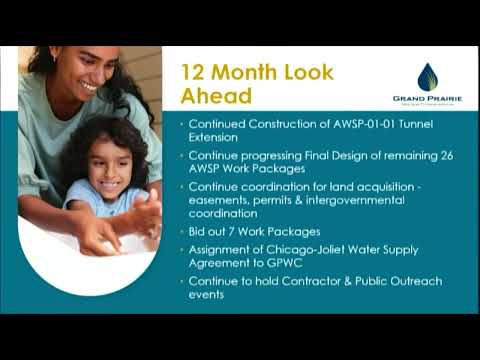
Construction is already under way on the first work package in Chicago — Swisher said a groundbreaking event was held the morning of June 2 — and she said that first package is expected to be complete by the end of next year (2026). Regional construction in the member communities is slated to begin in 2026, and staff expect to advertise bids for more than seven projects in the coming 12 months. Swisher cautioned that permitting and property acquisition will be “a heavy lift,” noting the program must obtain more than 400 temporary and permanent easements.
Swisher told the council that Joliet will soon see an administrative item asking the council to approve an assignment of the City of Chicago water supply agreement to the Grand Prairie Water Commission; she said that assignment is expected to be brought to the council for approval in July 2025. The agenda for the June 2 meeting also included a resolution to appoint an alternate commissioner to the Grand Prairie Water Commission (the agenda named Councilman Joe Clement), but the provided transcript does not record a council vote on that item.
Swisher closed by describing the commission’s public outreach plan — monthly social posts, a quarterly newsletter, quarterly resident meetings in Chicago neighborhoods affected by construction and an annual contractor outreach event planned for September — and encouraged residents to consult the Grand Prairie Water Commission website for documents and project status updates.