Get Full Government Meeting Transcripts, Videos, & Alerts Forever!
Get email alerts on the Shelter And Supportive Housing topic
No spam. Unsubscribe anytime.
Kenmore committee reviews where shelters and supportive housing are allowed, plans community outreach and June panel
Summary
City committee members and consultants reviewed state zoning requirements for emergency shelters, transitional and permanent supportive housing, discussed community outreach materials and funding sustainability, and planned a panel for late June to collect case‑study input.
Members of a Kenmore city committee reviewed how state law and local zoning interact for emergency shelters, transitional housing and permanent supportive housing, discussed common community concerns and outreach materials, and planned a panel on June 25 to gather case‑study input and provider experience.
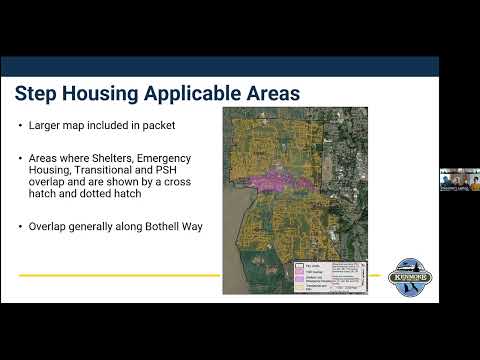
Committee members and the consulting team walked through statutory definitions and a zoning map showing where shelters and supportive housing would be allowed if the city applies the state definitions. Staff noted the Growth Management Act (RCW 36.70A) and related statutory definitions govern where emergency and shelter uses must be permitted, and the consultants supplied maps identifying zones where hotel, residential and certain commercial uses overlap with allowed shelter types.
Why it matters: zoning changes and outreach guidance will shape where permanent and temporary housing can be developed, how the city communicates with neighbors, and what mitigation — for example, design, parking or safety measures — the city can require at the application stage.
Key points from the meeting
- Statutory footing and zoning: The consultants said state law ties emergency shelter allowances to zones that permit hotels and residential dwellings; the packet included a map showing where those underlying uses occur across Kenmore. The consultants recommended using statutory definitions in local code so city terminology aligns with grant and provider practice.
- Transit and utilities: Committee members asked whether transit access is a statutory requirement; consultants said the Growth Management Act does not require proximity to bus rapid transit or similar systems as a condition for allowing shelters — allowances are tied to underlying zone uses. Committee members also raised septic and utility constraints in parts of the region; staff said those infrastructure limits remain a separate development constraint even if a use is permitted by zoning.
- Homeowner associations and deed restrictions: Members asked whether HOAs or deed restrictions can block the new housing types. Consultants said state law does not automatically void existing private covenants; the city regulates zoning but cannot unilaterally remove private deed or HOA restrictions. The consultants offered to follow up with a written clarification.
- Unit counting and density: The group discussed how middle‑housing changes (e.g., allowing more units per lot) intersect with supportive or transitional housing. Consultants said, if a use is not separately defined, unit counts follow the same density rules as other housing types in the zone; in some residential areas that could mean small site conversions, and in others only denser, multifamily sites would be feasible.
- Inventory and pipeline: The packet referenced older inventory data for deep‑affordability (0–30% AMI) — the consultants cited a figure of 359 units for that band from the dataset used in the packet and noted that some pipeline projects (for example, Imagine Housing and shelter projects cited in discussion) already contribute toward targets. The consultants cautioned the committee that capacity targets in the comprehensive plan demonstrate sufficient capacity but do not stop future housing work if targets are met.
- Community concerns and outreach: Committee members and attendees identified recurring community concerns — public safety, drug use, parking, effects on schools and neighborhood character — and recommended proactively addressing them with clear materials. Suggestions included: describing who typically lives in each housing type, case studies showing outcomes (including successful and problematic examples), good‑neighbor agreements, service partnerships such as on‑site caseworkers, and before‑and‑after cost comparisons related to public services.
- Funding sustainability and grant competitiveness: Multiple attendees raised concern about the sustainability of funding for supportive housing projects if state or federal funding priorities change. The consultants said project design sometimes follows grant priorities and recommended describing funding sources and partnerships in outreach materials so residents understand who is paying for operations versus development.
- Case studies and code examples: The consultants provided case study materials from nearby jurisdictions (materials in the packet referenced ordinances and examples from Bothell, Edmonds and Lynnwood) and recommended the committee identify code provisions — such as design standards, parking or good‑neighbor agreement checklists — that could be used proactively to mitigate perceived impacts.
Quotes and attribution
The meeting featured extensive discussion among committee members, consultants and attendees; speakers who were identified in the record include Clay White (consulting team member), Nick Chen (consulting team member who attended a prior meeting) and a staff member who prepared maps. Many comments came from unnamed committee members and residents; the article attributes ideas and questions to generic speakers where the transcript did not include a clear name.
Next steps and schedule
Staff and the consulting team will refine outreach materials and code recommendations based on the committee discussion and submitted case‑study suggestions. The committee set a panel discussion for Wednesday, June 25, 5–6 p.m., to hear provider experiences, implementation lessons and examples of outreach/code language that has worked elsewhere. The consultants said they will circulate packet materials and ask committee members for questions to send to the panel in advance.
Ending
Committee members emphasized that Kenmore must balance preserving neighborhood character with meeting statutory capacity and community needs; the consultants said they will follow up on outstanding technical questions (septic limits, HOA/deed restriction implications and exact unit‑count rules) and return with more detailed code recommendations and outreach templates in coming meetings.