Get Full Government Meeting Transcripts, Videos, & Alerts Forever!
Get email alerts on the Dnr Reorganization topic
No spam. Unsubscribe anytime.
House committee advances wide-ranging DNR reorganization bill with carbon sequestration, legacy remediation changes
Summary
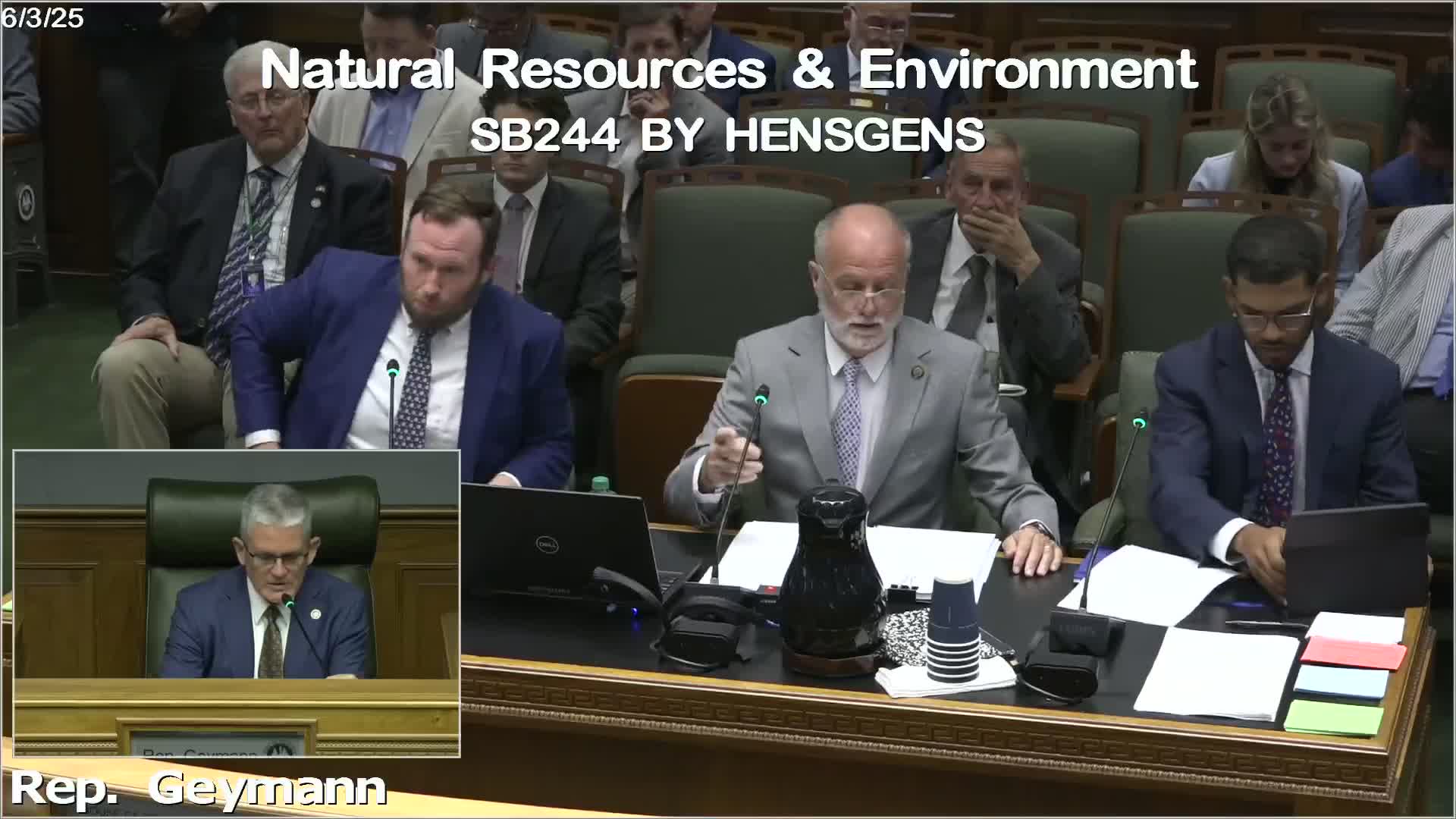
The House Natural Resources Committee on June 3 reported Senate Bill 244 favorably after adopting a broad amendment package that reorganizes the Department of Energy and Natural Resources and adds rules on carbon sequestration, water management and legacy oilfield remediation.
The House Natural Resources Committee on June 3 reported Senate Bill 244 favorably after adopting a broad set of amendments that reorganize the Department of Energy and Natural Resources and add provisions on carbon dioxide sequestration, water-resource management and legacy oilfield remediation.
The committee voted to adopt amendment set 3,569 and then to report SB 244 as amended; the roll call showed 13 yes votes and two no votes. Chairman Guymon presided over the meeting and Senator Henskins presented the bill on behalf of the Senate author.
The amendment package replaces the former Office of Conservation and the Commissioner of Conservation terminology with the secretary and renames the department the Department of Energy and Conservation. Deputy Secretary Dustin Davidson said the changes primarily reassign responsibilities rather than alter policy. "What you're seeing is just a changing of the name of who oversaw those activities," Davidson said during his presentation.
Amendments added provisions that would: require the department to prioritize public water supplies; provide confidentiality rules for competitive mineral-leasing processes; require advance notice by certified mail to owners near proposed Class VI well or related carbon-capture applications; define common carriers in the carbon dioxide sequestration chapter; and add a voluntary alternative dispute resolution and a hearing-master process for certain department adjudications.
Governor Landry, who addressed the committee during the debate, described the package as a balanced approach to longstanding disputes over property rights and oilfield liabilities. "This creates a date certain time. It creates some certainty after that particular date," he said, urging passage so the legislature can set ground rules for property owners and industry.
Members raised multiple concerns in committee. Several representatives and industry and landowner witnesses objected to amendment 39, which adds legacy remediation and litigation provisions and includes a paragraph restricting indemnity agreements. Don Caffrey of the Natural Resources Management Association and others said the anti‑indemnity language could invalidate longstanding contractual arrangements and chill future mineral leasing. "By eliminating those contracts, servitudes, whatever they may be, we are now in a position that those can't be assigned or they won't be offered to be assigned, blocking us out of any mineral exploration on those properties," Caffrey told the committee.
Representatives from environmental groups and water districts said the measure is large and complex, and they urged more time for review. Kathy Waskin of the Louisiana Environmental Action Network warned the bill contains statewide groundwater and surface-water management provisions that could require additional staffing and regulatory resources; she said fiscal impacts were not detailed in the amendment packet. Sierra Club Delta Chapter representative Marlee Montgomery said the proposed department would have broad authority to reorganize divisions and urged additional review time.
Committee members also discussed procedural mechanics of the proposed hearing-master and appeals process. Senator Henskins and department staff described a voluntary model in which disputing parties would select a hearing master from a vetted list and could request a three-judge review panel by a similar selection process; the department would maintain the list but not control appointments.
On carbon sequestration, amendments include notice requirements intended to notify mineral lessees when a CO2 lease or sequestration project may affect mineral rights. The committee added a requirement that the department publish notices of related applications on its website. Deputy Secretary Davidson said geologists and engineers would provide plume information and that the department would work to make maps and application materials available to buyers and other interested parties.
Several members urged further cleanup of statutory language where text transferred from other agencies—such as the former Capital Area groundwater authority—created uncertainty about the bill's statewide application. Chairman Henskins and Secretary Gray said they would continue to work with members and stakeholders between committee action and any floor or conference actions.
The committee adopted the amendments and reported SB 244 favorably as amended; a roll-call tally recorded 13 yes votes and two no votes. Several committee members and witnesses said they expect follow-up negotiations in conference or on the floor to refine portions of the package, particularly the legacy-remediation and indemnity language.
Reporters and constituents seeking the department's application materials or maps for proposed carbon-sequestration projects were directed by department staff to the department website, and staff said they would work to make plume maps and application details clearer for potential mineral buyers.
The committee also asked the department to clarify any fiscal staffing requirements tied to expanded groundwater and surface-water monitoring provisions before the measure reaches further stages of the legislative process.