Get Full Government Meeting Transcripts, Videos, & Alerts Forever!
Get email alerts on the Veteran Behavioral Health topic
No spam. Unsubscribe anytime.
OHA outlines $2.2 million veterans behavioral‑health program, cites 2019 study and peer‑support focus
Summary
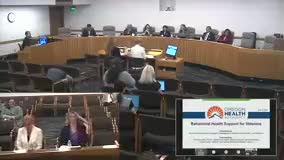
Krista Jones, behavioral health deputy director at the Oregon Health Authority, told the House Committee on Emergency Management, General Government, and Veterans on June 3 that OHA’s veteran and military behavioral health program was allocated $2,200,000 for this biennium and funds peer support, tribal grants, training and suicide‑prevention work informed by a 2019 improvement study.
Krista Jones, behavioral health deputy director at the Oregon Health Authority, told the House Committee on Emergency Management, General Government, and Veterans on June 3 that OHA’s veteran and military behavioral health program grew from a 2019 improvement study and is funded through the state’s veteran services fund.
Jones said the 2019 Oregon Veterans Behavioral Health Service Improvement Study produced recommendations that have driven programming across three biennia. “The recommendations drive the programming funded by the veteran and military behavioral health program,” Jones said. Examples she described include provider competency trainings, tribal behavioral health grants, peer support specialist grants, firearms safety and suicide‑prevention outreach, and pilots such as a Brain Injury Care Navigator and parenting supports for service members and veterans who are caregivers.
Why it matters: OHA reported that the veteran and military behavioral health program was allocated $2,200,000 for the current biennium and that the agency expects to expend that full amount on direct behavioral‑health services for service members, veterans and their families.
Susan Davis, OHA’s veteran and military behavioral health liaison, summarized program areas that align with the 2019 recommendations: cross‑sector community projects, outreach to destigmatize behavioral health treatment, development of peer‑support models, increasing non‑VHA providers’ competency in military cultural awareness, and routine collection of veteran status and social determinants of health data in funded programs.
Jones and Davis said some program elements are intentionally nonclinical—such as peer support—but are considered part of behavioral‑health service delivery and are used alongside clinical care. “Peer support can be a part of a treatment plan for an individual,” Jones said, adding that peer services often operate as part of a multidisciplinary team.
OHA reported a range of funded services and pilot projects and said several service areas have already exceeded projected numbers served; full reporting on numbers served will continue through mid‑August 2025. Jones said outreach activities such as the Veterans Village at Pride events—scheduled in multiple Oregon cities—are expected to more than double the number of service members, veterans and families reached by that outreach component.
Committee members pressed OHA for additional data. Jones said she did not have on‑hand the percentage that OHA’s allocation represents of the Measure 96 1.5% total and agreed to provide that figure in writing. Several lawmakers asked for more detailed breakdowns, including the number of combat veterans in the state, the percentage of service providers who are veterans, and program‑level counts for peer and clinical services. OHA agreed to provide follow‑up information in writing.
A legislator raised concerns about the scope and cost of a multi‑year study OHA conducted on ibogaine; Jones said OHA would provide documentation and analysis in writing to address the questions. The committee recessed without making policy changes; members asked OHA to return written materials for review.
OHA closed by sharing participant comments from funded programs, including statements that participants felt supported and that combined modalities (for example, mindfulness, equine exposure, yoga and acupuncture) were helpful to attendees. Jones and Davis said programming includes targeted efforts for rural veterans, tribal populations, LGBTQ+ veterans and justice‑involved veterans.