Get Full Government Meeting Transcripts, Videos, & Alerts Forever!
Get email alerts on the Transportation And Economic Development topic
No spam. Unsubscribe anytime.
Subcommittee advances HB 5024 revising Oregon Business Development Department budget; lawmakers flag broadband, trade and one‑time funding cuts
Summary
The Ways and Means Transportation and Economic Development Subcommittee voted to move House Bill 5024 — the Oregon Business Development Department budget bill — to the full committee with a due‑pass recommendation after adopting a dash‑3 amendment reflecting Legislative Fiscal Office recommendations.
The Ways and Means Transportation and Economic Development Subcommittee voted to move House Bill 5024 — the biennial budget for the Oregon Business Development Department (OBDD) — to the full committee with a due‑pass recommendation after adopting a dash‑3 amendment based on the Legislative Fiscal Office (LFO) recommendation.
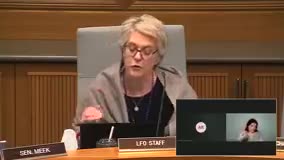
The LFO recommended a 2025–27 total‑funds budget for OBDD of $1,801,284,094.20, with 200 positions and 196.13 FTE; the recommendation reflects a 20.8% decrease from the legislatively approved budget because of the phase‑out of one‑time funding and a 56.5% increase from the 2025 current service level, LFO staff said. Representative Kate moved the LFO recommendation and later moved the bill as amended to the full committee; after floor discussion she announced she would vote no on final passage.
The nut graf: the subcommittee’s action preserves continuing programs, authorizes one‑time carryovers and narrows policy decisions on infrastructure financing to the capital construction subcommittee, while trimming the strategic reserve and applying vacancy‑savings adjustments that members said respond to reduced ongoing revenue.
Key budget items and packages described by LFO staff included: - Operations division: $30,700,000 total funds, 71 positions (67.88 FTE), funded from a mix of general fund, lottery, other and federal funds. The LFO recommendation incorporates four central‑services positions added by an emergency board action to support accounting and procurement tied to infrastructure investment disbursements. - Business Innovation & Trade (BIT): recommended funding that restores proposed gubernatorial reductions for the Oregon Metals Initiative and OMIC to current service level; a $400,000 lottery‑fund package (Package 107) to support contracted services for international trade (described by the LFO as focused on markets including Japan and Canada); and $8.5 million in lottery carryover for specific projects (Package 124). - Infrastructure and broadband: authorization of expenditure limitation for broadband programs (Package 123) including a carryforward of federal funds for the Broadband Equity, Access and Deployment (BEAD) / Oregon Broadband Office activities (LFO cited about $161 million total funds, largely federal). The recommended infrastructure division budget included positions to support broadband equity, access and deployment grant management. - Capital carryovers and funds: other funds capital projects carryover (Package 126) includes $44.1 million (BIT) and larger sums in the infrastructure program (LFO cited $263.1 million other funds carryover for prior Infrastructure Finance Authority projects). The recommendation also includes $10 million for the University Innovation Research Fund and funding tied to the Oregon CHIPS Fund. - Arts, film and cultural funding: carryovers and spending authority for previously appropriated arts projects and the Oregon Cultural Trust distributions; a continued appropriation for the Oregon Film and Video Office at current service level. - Strategic reserve: the LFO recommended a $1.1 million permanent reduction to the strategic reserve, leaving a recommended balance of $12.1 million in lottery funds for 2025–27.
Committee discussion highlighted several themes: Representative Wynne urged stronger international trade support and asked whether there is a trade mission “playbook” and whether non‑governor officials could expand trade outreach; the LFO replied that Package 107 supports contracted services for offices focused on Japan and Canada. Multiple members raised concern about relying on one‑time pandemic and federal funding and the difficulty of sustaining programs once those funds end. Several members pressed staff on technical assistance funding for underserved communities, which LFO staff said was not continued in the recommended budget and would require advocacy to the co‑chairs or placement in a policy bill or reconciliation vehicle if advocates seek restoration.
Formal actions taken by the subcommittee: - Adoption of the LFO dash‑3 amendment to HB 5024 (mover: Representative Kate); the amendment reflects the LFO recommended changes by fund and position counts and was adopted before the final motion. - Motion to move HB 5024 as amended to the full Ways and Means Committee with a due‑pass recommendation (mover: Representative Kate). The motion passed on roll call; Representative Kate stated she would vote no despite moving the bill, citing concerns about added positions and long‑term sustainability. Other named members recorded as voting yes included Representative Wynne and Representative Scarlatos; some members were recorded as excused.
Discussion versus decisions: the subcommittee vote approved the LFO recommended budget and the dash‑3 amendment (formal decisions). Many policy questions — for example, any infrastructure financing levels and specific allocations tied to capital construction — were left to the capital construction subcommittee, and technical assistance for underserved communities was left without restoration in the recommendation (discussion and potential follow‑up). LFO staff repeatedly noted that project carryovers are reimbursement‑based and that capital subcommittee and emergency board actions affect timing and staffing needs.
Clarifying details recorded in the meeting record: total budget numbers and FTE counts quoted above; LFO‑listed package amounts (examples: $400,000 lottery for international trade contracted services; $8,500,000 lottery carryover in BIT; $44,100,000 other funds capital carryover in BIT; $263,100,000 other funds capital carryover for infrastructure finance authority projects; $161,000,000 total funds (primarily federal) in support of broadband equity/disbursements; $1,541,600 proposed for the Oregon Film and Video Office; strategic reserve reduction of $1,100,000). Several package numbers were described as rounded by LFO staff.
Background and next steps: LFO staff said some policy option packages tied to infrastructure financing are the purview of the capital construction subcommittee. Committee members were told the subcommittee will consider the Department of Consumer and Business Services budget at the next meeting and were reminded of end‑of‑session timing constraints. The bill and amendment now go to the full Ways and Means Committee for further consideration.
Ending note: the subcommittee’s action preserved a mix of carryovers and program restorations while trimming the strategic reserve and applying vacancy savings. Committee members asked LFO and OBDD officials for follow‑up on federal pilot funding for technical assistance and on details of trade outreach supported by the contracted services package.