Get Full Government Meeting Transcripts, Videos, & Alerts Forever!
Get email alerts on the Police Oversight topic
No spam. Unsubscribe anytime.
Lawrence review board questions transparency and scope after monthly complaint report and resignation letter
Summary
Members of the Lawrence Community Police Review Board pressed the police department for more detail about two recent citizen complaints and debated whether the board’s oversight role and access to information are sufficient after receiving a resignation letter from a board member.
Members of the Lawrence Community Police Review Board pressed the Lawrence Police Department for more detail about two recent citizen complaints and debated whether the board’s oversight role and access to information are sufficient after receiving a resignation letter from board member Caleb Stevens.
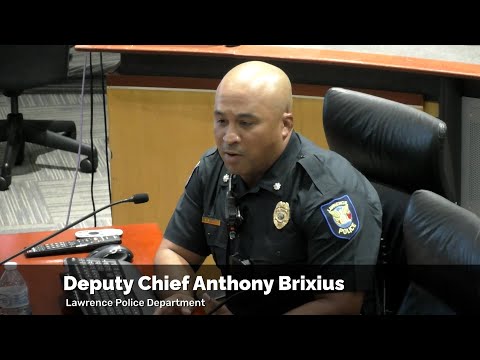
The discussion came during the board’s monthly complaint report, when Deputy Chief Anthony Bridal summarized two investigations: a sustained training-related violation involving a trainee who stopped a motorist for a defective brake light, and a separate complaint (PC25008) from a Hispanic woman who said an officer’s tone and actions made her feel “scared and unsettled” and that the stop felt racially motivated.
The complaint summary reviewed by the board says the second stop was for an obstructed license plate, that officers asked the driver to step back to a patrol vehicle and requested consent to a pat-down (which was denied), and that the recorded encounter lasted “about 7 or 8 minutes.” The Office of Professional Accountability reviewed video of the stop, met with the complainant and ultimately recorded an exoneration for the officer. "In the state of Kansas, you have to have 2 working taillights," Deputy Chief Anthony Bridal said while explaining the department’s vehicle-equipment standard and the first (sustained) training finding.
Board members repeatedly pressed for more context about how investigators reached the exoneration in PC25008 and whether routine practices — such as moving a motorist to the patrol vehicle — are used consistently or only in higher‑risk interdiction stops. "That is often the case ... they almost always bring people back to their car, and it's because they're just talking to them and getting a baseline," Bridal said, describing common safety and investigative approaches. Several board members said summaries provided in the public meeting lack the level of detail they need to assess whether the department’s internal reviews are thorough.
Chair (name not specified) noted the working group that drafted the ordinance establishing the board had discussed similar limits and said the board does not have investigatory capacity: "I don't think this raises anything that wasn't discussed in great detail last summer," the chair said, adding that the board's role was constrained by the ordinance as adopted. Board members and department representatives agreed that appeals that come to the board are heard in executive session to protect privacy and that much investigative detail is handled through the Office of Professional Accountability.
Board members also discussed a resignation letter from Caleb Stevens that questioned the board's purpose and scope. Several members said Stevens’s points reflected frustrations they have heard, particularly about public willingness to pursue appeals. One board member observed that the low number of appeals could indicate either that the internal process is working or that people are reluctant to pursue escalation: historically, board members said, only two appeals have been filed and one appellant failed to attend.
Deputy Chief Bridal and others described the department’s review process as multi-layered: field supervisors, the Office of Professional Accountability (Major Cooper was named as a point of contact), the chief's office, the city attorney and city management may all review certain complaints. The department estimated it handles roughly 15 to 30 externally filed complaints at the higher levels annually after excluding personnel/internal investigations. Bridal said sustained findings are acted on — "it actually allows us to go in and train," he said — and that disciplinary outcomes can range from retraining to suspension or termination depending on the severity.
Board members asked for more de‑identified detail in future reports and for opportunities to learn department practice firsthand; the chair encouraged members to consider ride‑alongs and attending recruit classes to better understand policing procedures. Chief Lockhart was asked to present findings from a community meeting at the board’s next session on July 16, and members said they would meet with department staff privately for more detailed follow‑up on specific cases.
No policy or disciplinary decisions were taken at the meeting. The board approved the March 19, 2025 minutes and later moved to adjourn; both motions carried by voice vote.