Get Full Government Meeting Transcripts, Videos, & Alerts Forever!
Get email alerts on the Mental Health topic
No spam. Unsubscribe anytime.
Richland County commissioners approve placing 1-mill mental health levy renewal on November ballot
Summary
The Richland County Board of Commissioners voted June 3 to approve a resolution of necessity asking voters to renew a one-mill property tax levy for the Richland County Mental Health and Recovery Services Board, placing the measure on the November ballot.
The Richland County Board of Commissioners voted June 3 to approve a resolution of necessity asking voters to renew a one-mill property tax levy for the Richland County Mental Health and Recovery Services Board, placing the measure on the November ballot.
The levy renewal would be a property-tax renewal at a rate the board described as equivalent to 10 cents per $100 of assessed value and has generated about $2.2 million annually in recent years. Board officials and county commissioners framed the request as continuing an existing funding stream that supports a local network of treatment providers, supported housing and crisis services.
Director Sherry Brown of the Richland County Mental Health and Recovery Services Board said the agency “is an efficient and an effective organization” and noted that a staff of seven administers the countywide continuum of mental-health and addiction services. Carrie's voice: Associate Director and CFO Carrie Vo told commissioners the board follows formal reserve policies for finances: “The administrative reserve is equal to one year of that budget line under the board expenditures. The program reserve is 34% of the contracted amount for all programs we fund. The capital reserve policy states $1,000,000, and a previous director increased that to $2,000,000.”
Why it matters: The levy is the principal local funding source the board uses to support contract and affiliate agencies that deliver direct services in Richland County. Commissioners pressed presenters on several financial and program details, including reserve levels, capital needs for board-owned housing, staffing and the board’s dependence on state and federal grants.
Board officials provided several financial and program details during the discussion. They said the board has roughly 58 “doors” (individual housing units) across multiple properties, including three at Alpine, one at Dalton and two buildings on First Street; the board also owns New Beginnings, withdrawal-management facilities and transitional programs. The board reported an architect/estimator quote of about $2.6 million to renovate several aging properties and said it has paused new construction while it prioritizes repairs to existing housing stock.
Officials told commissioners that in recent years the levy has generated about $2.2 million annually and that, under the board’s five‑year projection, the organization could show approximately $2.8 million in excess cash at one point in the projection. Commissioners raised that projected surplus as a taxpayer concern; Carrie Vo and Sherry Brown responded that some of those projected balances reflect funds planned for capital projects and contingencies because state and federal funding levels (and the timing of those funds) are uncertain.
Funding uncertainties cited by board staff included pending OhioMHAS (state) allocations and federal grant awards. Board staff said they had received $1.2 million under a current federal grant year but warned the grant’s future funding is not guaranteed and that some federal block grants statewide may face cuts. Staff also cited possible changes to Medicaid expansion funding and described reserves as a buffer to avoid abrupt service cuts.
Commissioners asked technical questions about compensation and accounting calendars. Board staff explained that their projections use the state fiscal year calendar for reporting to the state, which can make comparisons with the county’s Munis calendar look different. Board staff described a practice of reviewing salary ranges against peer counties every two years (and more recently more frequently) and said the board has job descriptions and pay ranges approved by its board of directors.
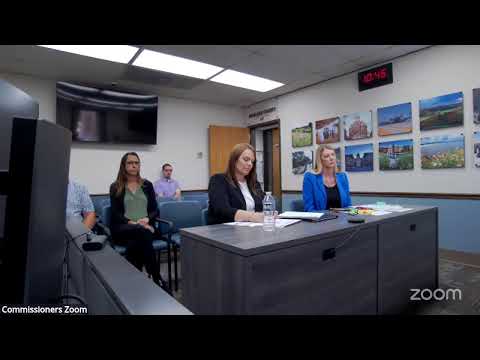
The board asked the commissioners to adopt a resolution of necessity to put the one-mill renewal on the ballot. Commissioners moved and seconded the resolution; the motion passed with the commissioners present voting in favor. County staff said the auditor will next calculate the exact ballot language and estimates; commissioners indicated they would convene again only if needed after the auditor’s review.
Direct quotes in this article are drawn from the meeting record. The vote, the levy rate described and the $2.2 million annual revenue figure were presented to the commissioners during the June 3 session.
Looking ahead, the mental health board and county staff said the levy renewal would be subject to the auditor’s certification and the normal election timeline before appearing on the November ballot. The board also said it intends to continue evaluating capital-repair needs and to pursue state and federal funding opportunities to supplement levy proceeds.