Get Full Government Meeting Transcripts, Videos, & Alerts Forever!
Get email alerts on the City Budget topic
No spam. Unsubscribe anytime.
Mesa council approves Fiscal Year 2025-26 budget despite five‑year deficit forecast
Summary
The Mesa City Council approved the Fiscal Year 2025‑26 budget and secondary property tax levy 6‑1 after debate over projected multi‑year deficits, use of reserves and recent revenue losses tied to state tax changes and a drop in residential rental tax.
Mesa — The Mesa City Council approved the city’s Fiscal Year 2025‑26 budget and secondary property tax levy in a 6‑1 vote Monday, after council members and staff debated a multi‑year deficit forecast and the city’s plan to use reserves to balance the coming year.
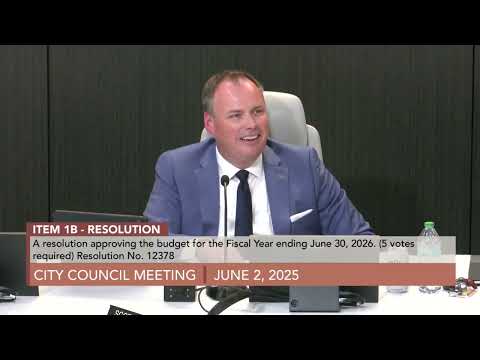
The council adopted a resolution approving the budget for the fiscal year ending June 30, 2026, after a public hearing that included one public commenter and a lengthy discussion among council members and staff about the causes of a projected structural imbalance. "The proposed budget that you're going to vote on this evening will show a general fund deficit of $108,000,000," public commenter Carrie Davis told the council during the hearing.
City staff and the new city manager said the near‑term imbalance stems from several factors, including a benchmarking increase for sworn public safety personnel and reductions in specific revenue streams. "A significant factor in that is the benchmark that the city conducted ... the sworn public safety was about $23,000,000 increase," said Brian Kennington, a city staff member who addressed the council's questions. City Manager Mr. Butler said, "we were hit with some unexpected circumstances ... and we had to stay competitive with our public safety funding." He said the city plans to use reserves responsibly while adjusting spending and monitoring revenues.
Council members debated how quickly to close a projected five‑year gap. Councilmember Rich Adams described the projection as too long a timeline for relying on reserves: "I am not comfortable on relying that on a 5 year projection. It's too long, in my opinion." Vice Mayor Summers and other council members defended the city's conservative forecasting approach, noting a multi‑year practice of adopting budgets that show negative net sources and uses while actuals often finish positive. Council members said the city’s reserves — described in meeting comments as about 34% — and prior conservative budgeting decisions give the council flexibility to make gradual adjustments instead of immediate deep cuts.
Staff cited several specific drivers of the projected deficit: the benchmarking increase for sworn public safety positions that added roughly $23 million, roughly $7 million of other unanticipated labor or service costs (about a $30 million incremental expense overall), a drop in residential rental tax revenue and a slowdown in sales tax collections. Staff also noted reduced state‑shared revenues after a state income tax change. Departments were asked for 2% base budget cuts during the process; staff said those department‑level reductions produced approximately $11 million in savings.
Council members emphasized the vote covered only the FY 2025‑26 budget and that budget monitoring and adjustments are ongoing. The motion to approve the resolution was made by Miss Billsbury and seconded by Councilmember Duff. The motion passed 6‑1; Adams cast the lone no vote. The mayor closed the public hearing before the roll call.
The council directed staff to return to the dais with additional scenarios and projections for the next budget cycle, including possible reduction scenarios of 2%, 2.5% and 3% for planning purposes, and to continue monthly monitoring of revenues and expenditures. The city also noted the charter requirement that any city sales tax increase must go to voters — a limit the council said it was not pursuing at this time.
Background and context: speakers during the hearing repeatedly described Mesa’s budgeting approach as conservative and iterative. Staff and council members cited past years in which adopted negative net sources and uses gave way to positive year‑end actuals. The Arizona Tax Research Association was referenced in the discussion as critiquing some cities for seeking tax increases rather than drawing on reserves in similar circumstances. The council meeting concluded after the vote and an adjournment motion.