Get Full Government Meeting Transcripts, Videos, & Alerts Forever!
Get email alerts on the Wastewater Treatment topic
No spam. Unsubscribe anytime.
Seaford council hears multi‑phase plan to raise wastewater plant to new treatment standard, expand capacity to serve future growth
Summary
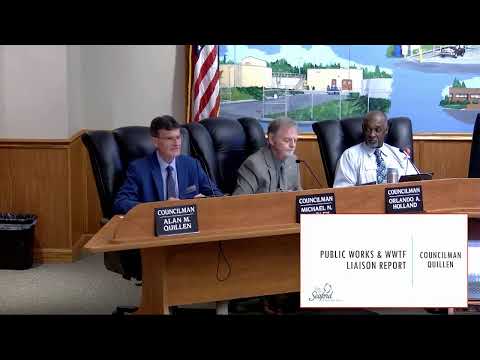
Seaford held a public hearing Tuesday on a proposed multi‑phase upgrade and expansion of the city’s wastewater treatment plant that engineers said is needed to meet discharge permit limits, replace aging equipment and prepare for sea‑level rise.
Seaford held a public hearing Tuesday on a proposed multi‑phase upgrade and expansion of the city’s wastewater treatment plant that engineers said is needed to meet discharge permit limits, replace aging equipment and prepare for sea‑level rise.
The presentation, led by Chris Derbyshire, said the work began as planning in 2016 and would be delivered in three phases: headworks/headroom upgrades (phase 1), liquid‑stream treatment conversion to a membrane bioreactor (phase 2) and biosolids/effluent disinfection work (phase 3). “It’s been in the works for a number of years. Actually started in 2016,” Derbyshire said.
The project team said phase 1 focuses on the headworks, new screening and grit removal, rehabilitation of primary clarifiers and a new septic receiving and equalization facility. Later phases would convert the biological treatment to a membrane bioreactor to reach the proposed nutrient limits and expanded capacity.
Why it matters: Engineering presenters said load limits tied to the city’s discharge permit effectively reduced the plant’s permitted capacity in recent years even though the physical plant was designed for 2.0 million gallons per day (MGD). Derbyshire said recent load trades and permit changes mean the city now averages about 1.45 MGD and that planning seeks to preserve headroom for growth and partner communities. The county has agreed to pay 40 percent of eligible debt service under the current interlocal arrangement, officials said.
Project scope, timing and cost: The consultants presented a $47 million combined estimate for all three phases. Phase 1 was scoped at about $14 million and includes design work for phase 2. Derbyshire said phase 1 construction is planned for fiscal 2026 and estimated at roughly 20 months; phase 2 is a 30‑month project beginning in fiscal 2028 and phase 3 a 20‑month project beginning in fiscal 2031. The presenters described a State Revolving Fund (SRF) financing structure with a 30‑year term and a low locked interest rate for SRF eligible amounts.
Technical drivers and vulnerabilities: Derbyshire described the selected treatment approach as an Enhanced Nutrient Removal facility using membrane bioreactor technology to lower nitrogen, biological oxygen demand and TSS. He and other staff also pointed to sea‑level rise and flood risk at low elevations of the existing headworks: “With the improvements that are proposed, we’ll obviously flood proof and harden the infrastructure,” Derbyshire said. Presenters showed maps and 60‑year projections for inundation and said each phase would include mitigation measures.
Funding and rates: City Manager Charles Anderson said phase 1 currently includes a $2.5 million federal earmark and SRF financing proposed at about $11.77 million. Anderson provided an engineering‑estimate debt‑service figure of about $523,590 annually for the combined financing and said the city’s share of the phase‑1 loan principal would be about $7.06 million (county paying 40 percent). The presentation estimated a needed sewer rate increase to cover half of the new debt service of about 4.79 percent (raising a $60.88 rate to roughly $63.80, or about $2.92 per month). Anderson cautioned those numbers were engineering estimates and could change after bidding.
Public questions and comments: Residents asked for updated background documents and questioned whether a 3.0 MGD ultimate capacity is necessary. Dan Cannon, a resident, said he supported upgrades but asked for more up‑to‑date PER (preliminary engineering report) work and alternatives analysis. Cannon asked for clarity on “how much and to what extent” the city needs to expand and requested an updated PER; he said “the less money we have to spend to do the expansion, then the less our sewer rates…are going to increase.”
County support and next steps: Hans Medlar, speaking for Sussex County engineering interests, said the county supports the project and urged use of growth‑related connection charges (impact fees) to finance the growth portion of the work: “Your rate payer should not be expected to pay this growth related component,” Medlar said. Council did not vote on final approval of the full plant project at the hearing; staff said next steps include finalizing SRF commitments, completing design and returning to council for bidding and contract approval as phases become bid‑ready.
Discussion vs. decision: The hearing was informational; staff received public comment. No ordinance or contract award for the treatment plant phases was adopted at the meeting.