Get Full Government Meeting Transcripts, Videos, & Alerts Forever!
Get email alerts on the Commute Trip Reduction topic
No spam. Unsubscribe anytime.
Committee fast-tracks four-year Commute Trip Reduction plan to meet state deadline
Summary
The Transportation Committee adopted a recommendation to pass a four-year Commute Trip Reduction (CTR) plan (Council Bill 120984) required by Washington state. SDOT officials said failing to adopt the plan by the June 30 deadline would risk state funding; the committee voted to forward the bill to full council.
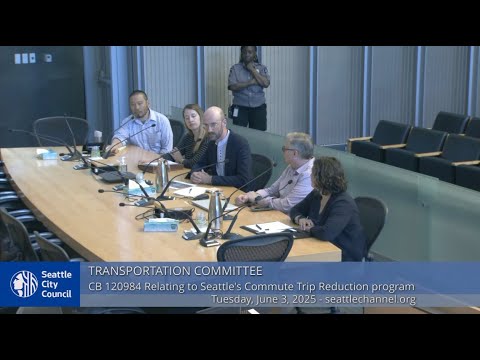
The Seattle City Council Transportation Committee on June 3 voted to recommend passage of Council Bill 120984, adopting a four-year Commute Trip Reduction (CTR) plan for 2025–2029 required by Washington state. Chair Rob Saka made the motion to recommend passage and the committee approved the recommendation on a 5–0 roll-call vote; the bill will be sent to the full City Council for consideration on June 10, 2025.
SDOT staff described the plan as an administrative requirement from the Washington State Department of Transportation (WSDOT). Matthew Treca and Sarah Spicer of SDOT said the city must adopt the updated CTR plan by June 30, 2025, to avoid risking state funding; SDOT estimated that in the last two-year cycle the related state funding was “a little shy of $1,500,000.” Treca summarized the program’s purpose: to work with large employers to reduce drive-alone commutes during morning peak hours and to encourage transit, walking, biking, carpooling and other shared modes.
Treca and SDOT staff outlined program mechanics: the CTR program covers large employers with 100 or more employees arriving between 6 a.m. and 9 a.m.; participating employers submit an employee commute survey and a worksite program report during the two-year cycle. SDOT staff said the city currently supports over 240 large employers representing more than 225,000 employees, and that the program has reduced drive-alone commutes at those worksites from 37% to 32.1% since 2008, which SDOT estimated removed about 11,000 vehicles from peak-hour roadways in 2024.
SDOT also explained employer compliance requirements in Seattle’s program: employers choose at least two strategies from each of three categories — employee information and amenities, subsidies and modal support, and parking management — and designate an employee transportation coordinator to be the point person at each worksite. Treca emphasized that employer targets are partnership goals intended to be reached in good faith and that employers submitting required surveys and program reports will be compliant with state law.
Committee members raised questions about implementation and local impacts. Councilmember Kettle and others discussed how major construction projects — including planned Sound Transit work — interact with CTR goals and employer mitigation. SDOT staff said they coordinate with employers and project teams and that employee transportation coordinators help distribute project and mitigation information to worksite employees. Vice Chair Hollingsworth asked how SDOT coordinates with King County Metro; SDOT staff said Metro is a close partner and that infrastructure investments (for example, near bus lanes and rapid-ride corridors) and service coordination are both important to reach targets.
At least one public commenter addressed transit more broadly before the agenda items were taken up. David Haines criticized aspects of transit safety and enforcement in Seattle; during his remote comment he said, among other statements, “We still don't have proper public safety implementation because we don't have a trustworthy chief and mayor.” Haines’s remarks were part of the public comment period and were not tied to any committee action.
Chair Saka noted the time-sensitive state deadline and, deviating from his normal practice of not voting on initial committee hearings, allowed the committee to vote on the ordinance at the same meeting to meet the state-imposed timeline. The clerk called the roll on the committee recommendation to pass Council Bill 120984; the clerk recorded the votes: Councilmember Kettle (Aye), Councilmember Rink (Yes), Councilmember Strauss (Yes), Vice Chair Hollingsworth (Yes) and Chair Saka (Aye). The clerk announced there were five votes in favor and zero opposed; the committee’s recommendation that council pass the ordinance will be transmitted to the June 10, 2025 City Council meeting.
SDOT identified next steps: adopt the 2025–2029 CTR plan at council, submit the finalized four-year plan to WSDOT by the state deadline, and notify CTR-affected employers of updated drive-alone targets and available tactics for the next four years.
No amendments were proposed during the committee action; the legislation was moved, seconded and recommended for passage.